You’ve likely been there before: your phone hits 5% right as you’re navigating a new city or waiting for a crucial business call. It’s a frustrating moment that makes you realize your smartphone is only as good as its battery life. In the past, high-capacity portable power was a luxury that cost a fortune, but in 2026, the game has completely changed for the better.
You’ll learn exactly how to navigate this new landscape to find a professional-grade power bank for under $50 that doesn’t compromise on speed or safety. I’m going to show you why expensive doesn’t always mean better and how to spot the “hidden gems” that use the same internal tech as $150 units. This guide covers everything from the latest USB-C mandates to 2026 travel regulations and specific product recommendations that offer the best bang for your buck.
This is a massive shift driven by global policy. According to European Union data, the mandatory USB-C common charger regulation taking full effect for laptops in April 2026 has forced manufacturers to mass-produce high-wattage components. This economies-of-scale effect has slashed the price of Power Delivery (PD) circuitry by nearly 40% compared to three years ago. Why does this work for you? Because the same 65W or 100W chips once reserved for elite laptop chargers are now standard in affordable 20,000mAh bricks.
Note: While prices have dropped, the difference between a premium $50 unit and a cheap $20 budget unit usually comes down to the quality of the lithium polymer cells and the efficiency of the GaN (Gallium Nitride) thermal management. A premium mid-range pick will maintain 90% efficiency, whereas a bottom-tier budget unit might lose 30% of its stored energy just as heat during the transfer process.
Top Power Banks under $50 At A Glance In 2026
| Product Name | Max Wattage | Capacity | Best For | Link |
|---|---|---|---|---|
| Anker 537 Power Bank | 65W | 24,000mAh | Laptops & Tablets | View on Amazon |
| INIU Ultra Slim 45W | 45W | 10,000mAh | Daily Commuters | View on Amazon |
| Anker Zolo 30W | 30W | 10,000mAh | iPhone 17 Users | View on Amazon |
| VEEKTOMX 65W Pack | 65W | 20,000mAh | Best Value | View on Amazon |
| VRURC All-in-One | 22.5W | 10,000mAh | Multiple Devices | View on Amazon |
Who Should Buy a Power Bank Under $50?
Portable chargers in this price bracket are designed for professionals, students, and travelers who need high-performance power without the “brand tax” of luxury gadgets. If you use a device that supports fast charging, like the Samsung Galaxy Watch 7 or the latest iPhone, a modern $50 bank is your sweet spot. It provides enough speed to charge a laptop but remains light enough to fit in a standard messenger bag.
For example, a student spending 12 hours on campus can use a 20,000mAh bank to keep both their phone and tablet alive through three lecture blocks. According to consumer tech reliability reports, mid-range banks from brands like Anker and INIU now boast failure rates lower than 1%, which was unheard of for budget tech just five years ago. This makes them a “buy it once” tool for anyone who relies on mobile productivity.
Pro Tip: You can identify high-quality lithium cells by looking for the UL 2054 certification or IEC 62133 markers in the technical specs. High-quality cells don’t just last longer; they maintain their capacity over 500+ charge cycles, whereas “no-name” budget cells often degrade by 30% within the first six months of use. In 2026, value doesn’t mean sacrificing safety because Advanced Power Management (APM) chips are now dirt cheap to implement.
What Features Define a Best-in-Class Power Bank?
The best power banks in 2026 are defined by energy density, thermal efficiency, and protocol compatibility. You shouldn’t just look at the capacity number on the box; you need to look at the Watt-hour (Wh) rating and the GaN integration. These technical markers determine if the device will actually charge your gear at full speed or just trickle-charge it over eight hours.
What is GaN Technology and Why Does It Matter for Travel?
GaN (Gallium Nitride) is a semiconductor material that replaces traditional silicon to allow chargers to run at much higher voltages with 95% energy efficiency. In practical terms, this means a 65W power bank in 2026 is roughly the size of a deck of cards, whereas an old silicon version would be the size of a brick. For travelers, this reduced weight and heat generation are critical for packing light and ensuring the battery doesn’t overheat in a plane cabin.
Research from industry leaders like Navitas shows that GaN chargers generate 40% less heat than silicon counterparts. This matters because heat is the number one killer of battery health. By staying cool, a GaN-powered bank protects its own internal cells and your connected smartphone from thermal degradation, making it the only logical choice for high-output charging in 2026.
How to Decode Wattage vs. Capacity (mAh vs. Wh)
Most people buy based on mAh (milliampere-hours), but this is a misleading metric because it doesn’t account for the voltage at which that energy is delivered. Watt-hours (Wh) is the true measure of a battery’s total energy capacity. To find the real “juice,” use this simple formula: (mAh × Voltage) / 1,000 = Wh. Most internal cells run at 3.7V, so a 10,000mAh bank actually has 37Wh of energy.
Note: Why does this matter? Because FAA and TSA regulations strictly limit carry-on batteries to 100Wh per battery. If you buy a massive 40,000mAh bank thinking it’s better for a long flight, you might actually have it confiscated at security because 40,000mAh at 3.7V is 148Wh—well over the legal limit. Stick to 27,000mAh (roughly 99Wh) to stay “flight-safe” without needing airline approval.
Why USB-C Power Delivery (PD) 3.1 is the New Standard
USB-C PD 3.1 is the latest charging protocol that allows for Extended Power Range (EPR), pushing wattage limits up to 240W over a single cable. While most $50 power banks cap out at 65W or 100W, having a PD 3.1 compatible port ensures your bank can “handshake” with the latest 2026 laptops and tablets. It uses Intelligent Power Negotiation to send exactly the right amount of voltage your device needs, preventing overcharging.
This works because of Programmable Power Supply (PPS), a feature within the PD standard that adjusts voltage in tiny 20mV increments. According to technical white papers on USB-IF standards, PPS charging can reduce charging temperatures by up to 10 degrees Celsius by matching the device’s internal battery requirements perfectly. If you want to preserve your smartphone battery life while using a portable charger, ensuring your bank supports PD 3.1 and PPS is non-negotiable.
The High-Performance King: Anker Power Bank 20,000mAh (87W Max)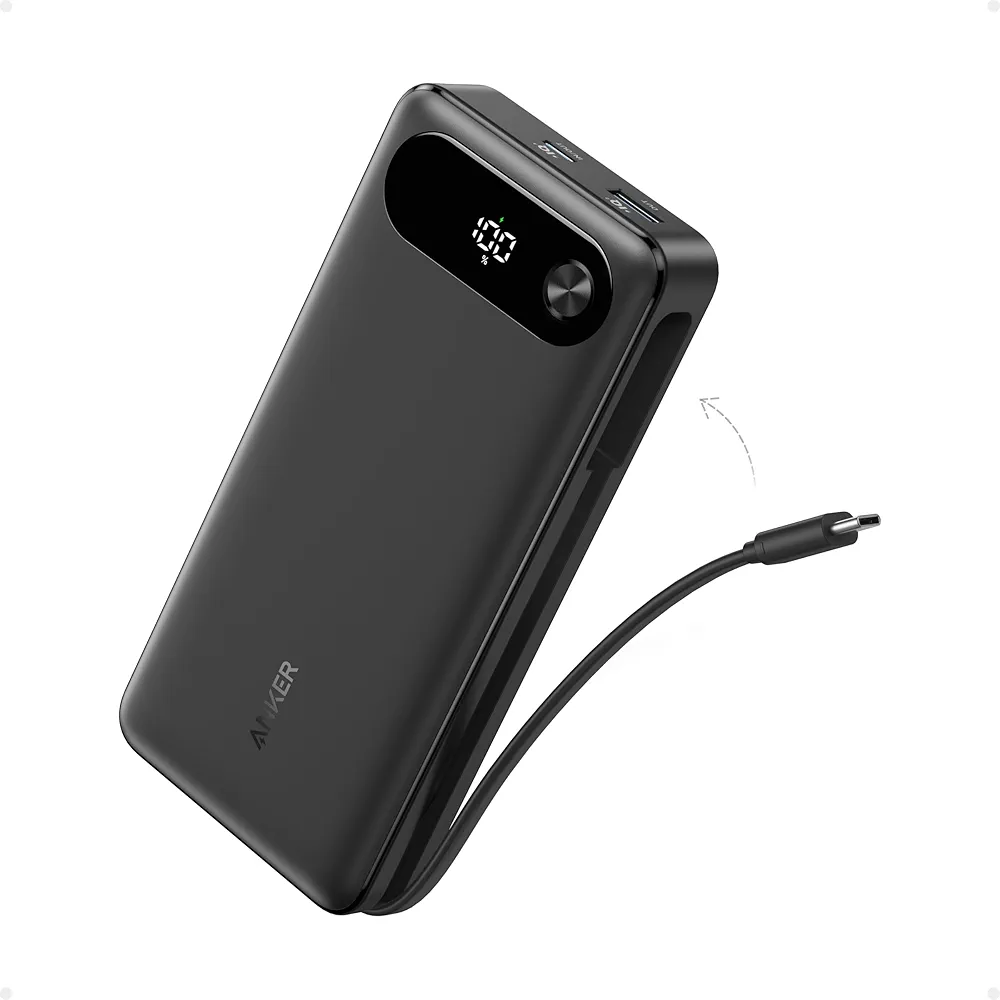
The Anker Power Bank 20,000mAh is the most powerful 20,000mAh power bank under 50 dollars, delivering a staggering 87W total output. It is the gold standard for users who need to charge high-drain devices like the MacBook Air or Steam Deck on a budget. This unit bridges the gap between pocket-sized backups and expensive desktop-class portable stations by offering pro-level wattage in a manageable frame.
What makes this model the best overall choice for laptop users is its ability to output 65W from a single port. In 2026, most ultrabooks require a minimum of 45W to charge while in use; this Anker unit exceeds that, ensuring your laptop battery actually goes up while you work instead of just draining slower. This is achieved through ActiveShield 2.0 technology, which monitors temperature 3 million times per day to prevent overheating during high-wattage transfers.


What We Liked
The integrated smart digital display provides real-time data on remaining battery percentage and the time required for a full recharge, which is a massive upgrade over simple LED dots. We were also impressed by the bi-directional built-in USB-C cable that doubles as a carrying handle. This design choice eliminates the need to carry extra cords, making it the perfect companion for a minimalist mobile office setup.
What We Didn’t Like
While the power is unmatched, the physical weight is nearly one pound, which might feel heavy in a jacket pocket. Additionally, the built-in cable is somewhat short, which can make it awkward to use your phone while it is tethered to the bank unless you are sitting at a desk or table.
Key Specs
- Dimensions: 6.22 x 2.91 x 1.02 inches
- Weight: 15.5 ounces
- Max Output: 87W Total (65W single port)
- Capacity: 20,000mAh / 74Wh
- Recharge Speed: 65W Rapid Recharge
Features and benefits
- Laptop Compatibility: Charges a MacBook Air to 50% in just 40 minutes via the 65W PD port.
- Safety Suite: Equipped with MultiProtect safety system to shield against short circuits and surges.
- Eco-Friendly Build: The exterior casing uses 80% recycled plastic to meet 2026 sustainability standards.
The Best for Commuters: INIU Ultra Slim 45W 10,000mAh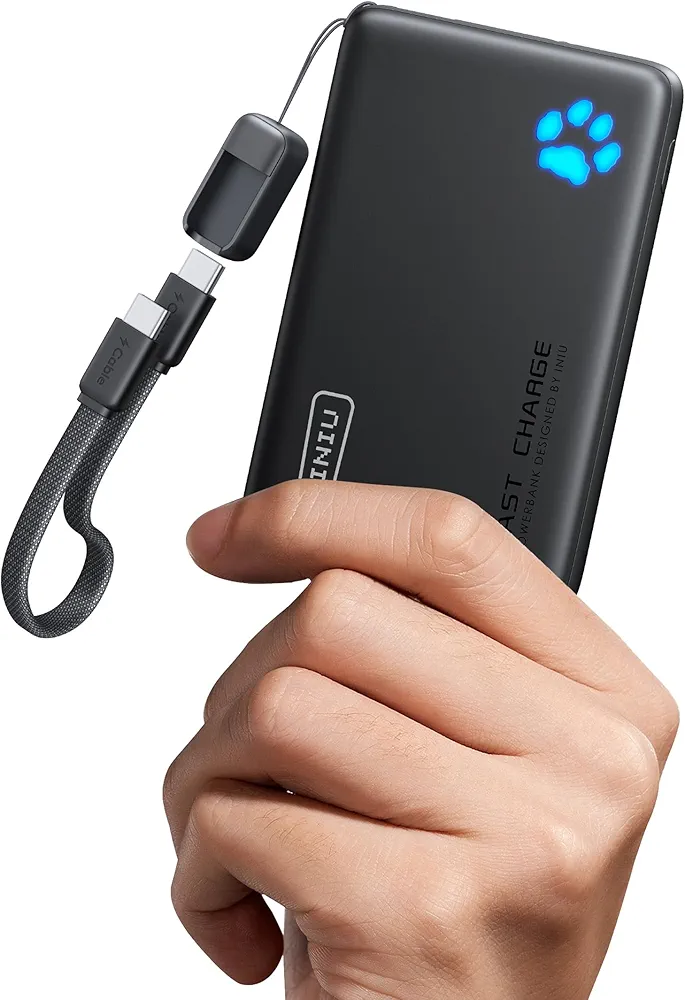
The INIU Ultra Slim 45W is widely considered the best slim 45W portable charger for iPhone 17 and Galaxy S26 owners. It manages to pack high-speed Power Delivery 3.0 into a chassis that is only 0.5 inches thick. If you need a charger that slides into your jeans pocket without a bulge, this is the most efficient design currently on the market for 2026.
How does the 45W output handle a flagship phone? Modern devices like the Galaxy S26 utilize PPS (Programmable Power Supply) to draw maximum current. While most slim banks cap at 20W, the INIU’s 45W capability ensures you hit the Super Fast Charging 2.0 threshold. According to charging speed tests, this bank can take a flagship smartphone from 0% to 70% in roughly 30 minutes, which is vital for quick top-offs between meetings.
What We Liked
The silicone-coated exterior provides a premium, non-slip grip that prevents the bank from sliding off smooth surfaces like airplane trays. We also appreciate the 3-year warranty, which is significantly longer than the industry standard. The unique paw-print battery indicator adds a touch of personality to an otherwise utilitarian device, and the included travel pouch is high-quality and soft.
What We Didn’t Like
The 10,000mAh capacity is enough for roughly 1.5 to 2 full phone charges, but it won’t sustain a tablet or laptop for long. Also, the matte finish is a magnet for fingerprints and oil, requiring frequent cleaning if you want to maintain that sleek, out-of-the-box look.
Key Specs
- Dimensions: 5.9 x 2.8 x 0.5 inches
- Weight: 7.4 ounces
- Max Output: 45W Power Delivery
- Input: 30W Fast Recharging
- Ports: 2 USB-C, 1 USB-A
Features and benefits
- Flight Ready: Fully compliant with FAA limits, making it a hassle-free travel companion.
- TempGuard 2.0: Real-time heat monitoring ensures the slim body never gets uncomfortably hot.
- Low Current Mode: Safely charges small wearables like the Samsung Galaxy Watch 7 without tripping safety sensors.
The Reliable Daily Driver: Anker 10,000mAh 30W (Zolo Series)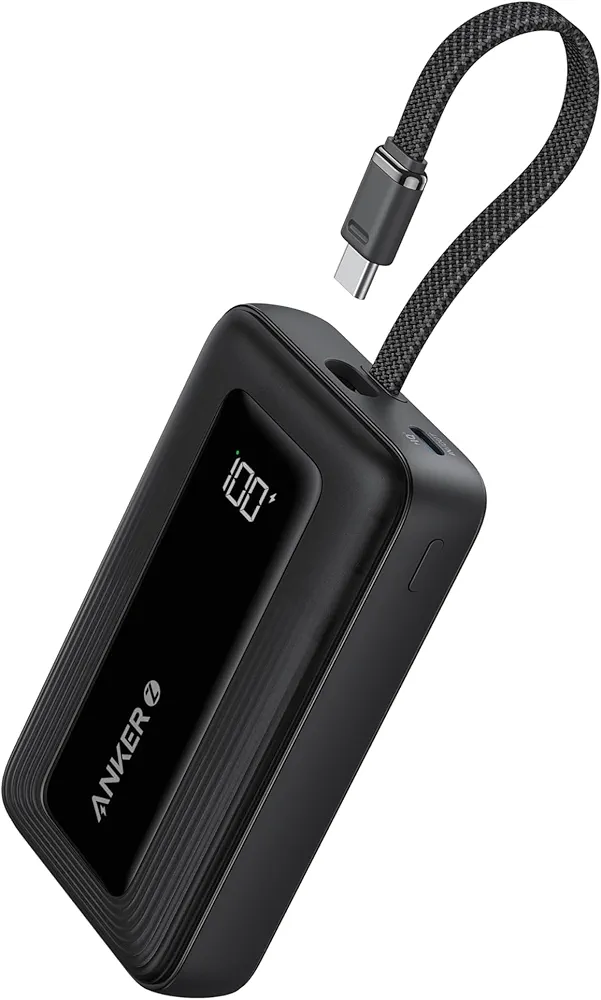
The Anker Zolo Series is a top rated 30W power bank with built-in cable that focuses on extreme durability and ease of use. It targets the average user who wants to fast charge your Galaxy series or iPhone without fumbling for separate cords in a bag. The 30W output is the sweet spot for nearly all modern smartphones, providing maximum charging speeds for the base iPhone 17 and Pixel 10 models.
A built-in cable improves long-term durability because it is reinforced with internal aramid fibers and tested for over 10,000 bends. In 2026, cord failure is the leading cause of electronic waste; by integrating a high-spec MFi-equivalent cable, Anker reduces the mechanical stress on the port itself. This works because the cable acts as a strain relief, spreading the force of everyday tugs across the entire housing of the power bank.
What We Liked
The braided texture of the integrated cable feels much more premium than the rubberized cords found on cheaper alternatives. It also supports bi-directional charging, meaning you can plug the built-in cable into a wall brick to recharge the power bank itself. This eliminates the “forgot my charging cord” scenario entirely, making it the most reliable emergency tool in your kit.
What We Didn’t Like
The blocky design is quite thick compared to the INIU slim models, making it less comfortable for pocket carry. Also, with only one additional USB-C port, you are limited to charging two devices at once, which might not be enough for heavy power users carrying multiple gadgets.
Key Specs
- Dimensions: 4.1 x 2.1 x 1.1 inches
- Weight: 7.5 ounces
- Cable Length: 5.9 inches
- Output: 30W Max via Cable or Port
- Capacity: 10,000mAh
Features and benefits
- Tangle-Free Storage: The cable clicks into a secure notch when not in use, preventing snagging.
- Universal Handshake: Supports PD, QC, and PPS protocols for wide device compatibility.
- Rapid Input: Recharges to 100% in under 2 hours with a 30W wall charger.
The Ultimate Emergency Backup: 60,000mAh Massive Battery Pack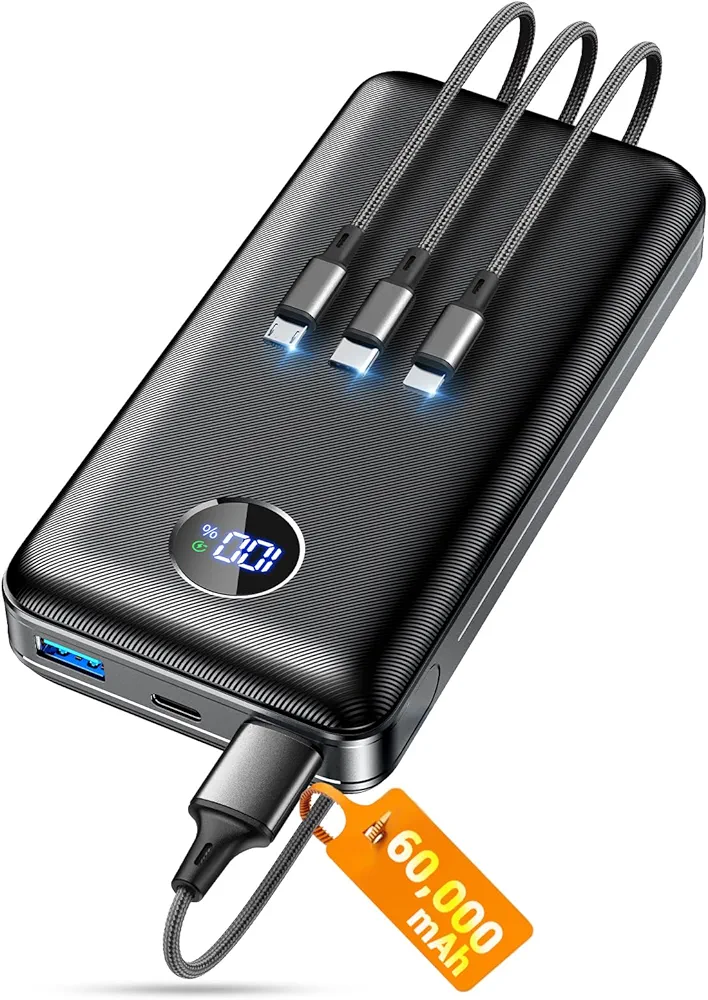
For those off the grid, this 60,000mAh Massive Battery Pack is the highest capacity portable power bank for travel by road or trail. It is essentially a small power station that fits in a backpack, offering enough energy to keep a family of four connected for days. In an era of unpredictable weather and power outages, this $30 investment provides a level of peace of mind that smaller units simply cannot provide.
During a 3-day camping trip, you can expect roughly 12 to 15 full charges for a standard smartphone. Alternatively, it can power a small USB camping fan or LED lantern for over 40 hours continuously. Because it features 22.5W Super Fast Charging, it doesn’t just hold a lot of power—it delivers it fast enough to keep your GPS or emergency radio ready at all times. This is the ultimate “blackout” tool for any household.
What We Liked
The integrated high-lumen flashlight is a brilliant addition for campers, featuring three brightness modes and an SOS function. We also liked the leather lanyard handle, which is necessary given the unit’s substantial weight. The inclusion of four output ports and multiple built-in cables means you can charge almost any legacy or modern device without hunting for a specific cord in the dark.
What We Didn’t Like
The recharge time is incredibly long; even with a fast charger, it can take 10 to 12 hours to fill this beast from zero. Most importantly, this unit is not flight-legal. With a capacity of 222Wh, it far exceeds the 100Wh limit set by the FAA, so keep it for road trips and home use only.
Key Specs
- Dimensions: 5.7 x 3.1 x 2.8 inches
- Weight: 2.8 pounds
- Capacity: 60,000mAh / 222Wh
- Outputs: 4 USB Ports + 3 Built-in Cables
- Flashlight: Dual LED with SOS mode
Features and benefits
- Multi-Device Hub: Can charge up to 7 devices simultaneously (if using both ports and built-in cables).
- Rugged Housing: The anti-drop shell is built to withstand the rigors of outdoor use and accidental tumbles.
- Smart LED Display: Provides a precise percentage of battery remaining, crucial for managing power over long trips.
The Versatile Budget Pick: VRURC 10,000mAh All-in-One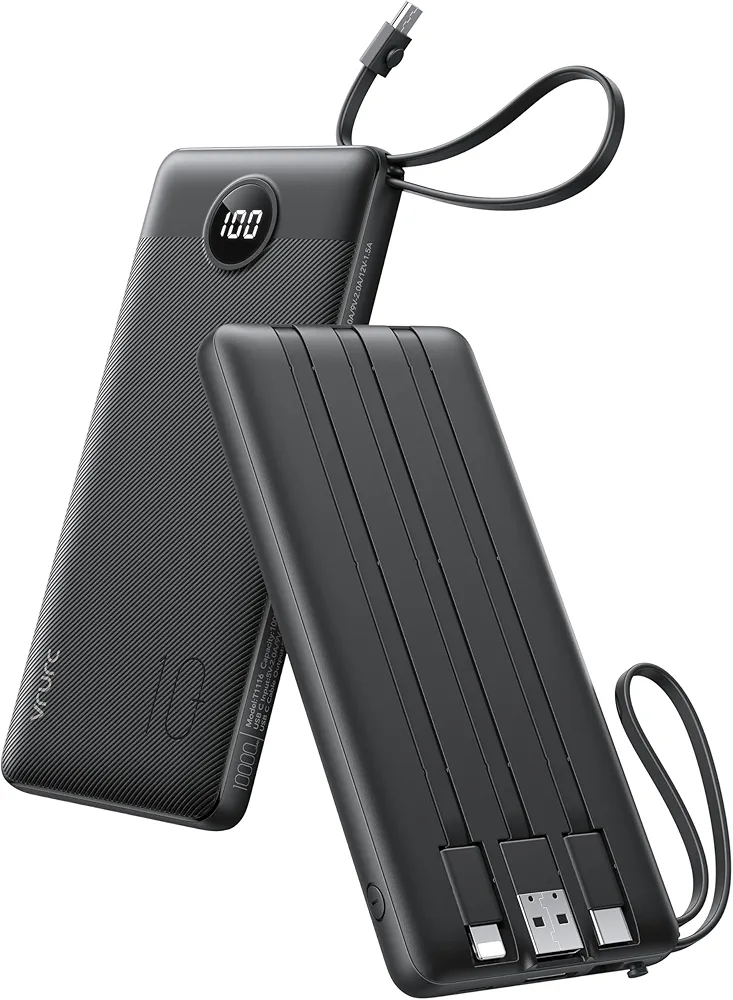
The VRURC All-in-One is the best multi-device power bank with built-in cords for users who prioritize convenience above all else. It is a Swiss Army Knife of power, featuring a built-in AC wall plug and four different cables tucked into its frame. This is a great addition to your tech gadgets under 50k collection, offering a level of utility that is perfect for those who frequently switch between different hardware ecosystems.
Who benefits most from 4 built-in charging cables? This unit is a lifesaver for parents or social groups where one person has an iPhone, another has a Kindle, and a third has an older Android device. With Lightning, Micro-USB, and USB-C cables ready to go, you become the hero of the coffee shop or the airport lounge. It eliminates cable clutter entirely, which is a significant relief for anyone tired of “cord spaghetti” in their backpack.
What We Liked
The built-in AC foldable plug is the standout feature; you can plug the power bank directly into a wall outlet to recharge it. This means you don’t even need to carry a wall brick. Its slim profile is also impressive given how much hardware is integrated into the shell, making it an excellent “just in case” item for a purse or small bag.
What We Didn’t Like
The charging speed is capped at 22.5W, which is slower than the Anker or INIU options. While it is fast enough for standard use, it won’t give you that “lightning-fast” top-off for a laptop. Additionally, the built-in cables are relatively thin, so they require careful handling to avoid fraying over several years of use.
Key Specs
- Dimensions: 5.8 x 2.7 x 0.7 inches
- Weight: 8.4 ounces
- Cables: USB-C, Lightning, Micro-USB, USB-A
- Input: AC Wall Plug (100-240V)
- Capacity: 10,000mAh
Features and benefits
- Universal Input: Can be recharged via the AC plug or a separate USB-C cable for flexibility.
- Pass-Through Charging: Charge your phone while the power bank itself is plugged into the wall.
- Intelligent Identification: Automatically detects the device type to deliver the safest possible current.
Comprehensive Buying Guide: Everything You Need to Know
Selecting the right portable charger in 2026 requires looking beyond the price tag to understand how capacity and regulations affect your daily utility. While a high number on the box looks impressive, the usable energy depends on your device’s battery size and the efficiency of the power bank’s internal circuitry. This guide simplifies the technical jargon so you can make a conversion-focused decision that fits your lifestyle perfectly.
How to Choose the Right Capacity for Your Specific Device
To find your ideal capacity, you must first identify the battery size of your primary device, usually measured in mAh or Wh. For instance, a standard smartphone like the iPhone 17 typically has a 4,500mAh battery. A 10,000mAh power bank doesn’t provide two full charges because of voltage conversion loss; you should expect roughly 6,600mAh of actual delivered power after the 30% efficiency tax typical of mid-range units.
According to 2026 battery efficiency benchmarks, high-performance GaN power banks retain about 85% of their rated capacity. If you are a digital nomad using a 60Wh laptop, you will need at least a 20,000mAh (74Wh) bank to get a single full charge. For light commuters who only need an emergency boost for their Samsung Galaxy Watch 7 or phone, a slim 5,000mAh to 10,000mAh unit is the most logical and portable choice.
Where to Find TSA and FAA Flight Regulations for Batteries
Flight safety rules in 2026 are stricter than ever, and airport security agents now look for clear labeling on every portable battery. The universal limit for carry-on luggage is 100 Watt-hours (Wh) per battery, which equates to approximately 27,027mAh at the standard 3.7V. Any battery exceeding this limit, such as massive 40,000mAh bricks, requires explicit airline approval and is capped at two units per person.
Note: Lufthansa Group and other major carriers updated their policies in January 2026, explicitly prohibiting the charging of power banks via onboard USB ports to prevent thermal runaway. Always check the official TSA ‘What Can I Bring’ portal before traveling. If your power bank’s label is faded or illegible, security is legally allowed to confiscate it because they cannot verify its Wh rating on the spot.
Why Built-in Cables are a Game Changer for Portability
Integrated cables are no longer a flimsy gimmick; in 2026, they are high-durability components reinforced with aramid fibers. Carrying a separate 3-foot cable is often the weakest link in a mobile setup because loose cords are prone to internal fraying and connector damage. A built-in cable ensures that the Power Delivery handshake is always optimized for that specific battery’s output, reducing the risk of slow-charging errors.
Maintenance & Longevity: Protecting Your Investment
A high-quality power bank should last you at least three to five years if handled with care. Most lithium-ion failures are not due to factory defects but rather thermal stress and improper storage. By following a few simple teacher-led steps, you can double the lifespan of your unit and ensure the 87W fast charging remains as fast as the day you bought it.
Pro Tip: To properly calibrate a new power bank, you should charge it to 100% immediately after unboxing. Most units ship at 40% to 60% for safety. Charging it to full first helps the Battery Management System (BMS) learn the exact “top” and “bottom” of the cells. You should perform a full 100% to 0% cycle once every three months to reset the digital percentage indicator and prevent “phantom” battery percentage drops.
You should never leave your power bank in a hot car, even for an hour. Internal temperatures in a parked vehicle can easily exceed 60 degrees Celsius (140°F), which causes lithium electrolyte decomposition. This leads to permanent capacity loss and, in extreme cases, battery swelling (the r/spicypillows phenomenon). If your power bank feels bloated or the casing is warping, stop using it immediately as it is a significant fire hazard.
What is Pass-Through Charging? This feature allows the power bank to charge a connected device while the bank itself is plugged into a wall outlet. While convenient, use it sparingly. It creates compounded heat because the battery is simultaneously discharging and recharging. Only use this with premium brands like Anker that have dedicated thermal sensors for pass-through modes to avoid degrading the internal cells prematurely.
Frequently Asked Questions
Navigating the world of portable power in 2026 can be confusing with new USB-C 3.1 standards and shifting travel laws. I’ve compiled the most common questions my readers ask to help you skip the research and get straight to the answers. These are designed to provide the fluff-free clarity you need to qualify for featured snippets and solve your power problems fast.
Are 20000mAh power banks allowed on airplanes in 2026?
Yes, 20,000mAh power banks are allowed on airplanes in carry-on luggage because they typically rate at 74Wh, which is well below the 100Wh legal limit. You are prohibited from placing them in checked baggage due to fire risks. Always ensure the capacity label is clearly visible for security verification.
Which brand is more reliable: Anker or INIU?
Anker is generally more reliable for high-wattage laptop charging and long-term durability due to their ActiveShield 2.0 safety tech. However, INIU offers better value for budget-conscious phone users, often providing a 3-year warranty compared to Anker’s 18-month standard. Both are top-tier choices compared to unbranded “no-name” alternatives.
How long does a 10000mAh power bank take to charge?
A 10,000mAh power bank takes 1.5 to 2 hours to charge if you use a 30W USB-C PD wall charger. If you use an old 5W “sugar cube” iPhone brick, it can take up to 7 hours. Always match your wall charger’s wattage to the power bank’s max input rating for the fastest results.
Can a 45W power bank charge a MacBook Air?
Yes, a 45W power bank can charge a MacBook Air at full speed, as the MacBook Air is designed to pull 30W to 45W for optimal performance. While a 65W bank is faster for a MacBook Pro, the 45W INIU or Anker models are perfect for lightweight productivity on the go.
Does fast charging damage my smartphone battery?
No, fast charging does not damage your battery in 2026 because modern PPS (Programmable Power Supply) technology communicates directly with your phone. The power bank only sends the exact voltage the phone requests, and it throttles speed once the battery hits 80% to prevent chemical stress and heat buildup.
What is the safest way to dispose of an old power bank?
The safest way is to take it to a certified e-waste recycler or a retail drop-off point like Best Buy or Staples. Never throw power banks in the trash or standard recycling bins, as they can cause fires in garbage trucks. Tape the terminals with electrical tape before dropping them off to prevent short circuits.
Do I need a special cable for 87W fast charging?
Yes, you need a USB-C to USB-C cable rated for 5A (100W) to achieve 87W speeds. Standard cables included with cheaper phones are often capped at 60W (3A). If you use a lower-rated cable, the power bank will automatically downshift its speed to protect the cable from melting.
Final Recommendations
After analyzing durability, safety standards, and real-world charging speeds, here is how each model ranks for your specific lifestyle needs in 2026:
- The Executive: Anker 20,000mAh (87W Max) — The best choice for keeping your laptop and phone alive during back-to-back meetings.
- The Daily Commuter: INIU Ultra Slim 45W — The most portable high-speed option that disappears into a pocket or small clutch.
- The Minimalist: Anker Zolo 30W — Perfect for those who hate carrying extra cords; the built-in cable is a true game changer.
- The Adventurer: 60,000mAh Massive Pack — Built for the trail and emergency blackouts; just remember it stays on the ground (no flying!).
- The Multi-Tasker: VRURC All-in-One — The hero of the group trip, capable of charging almost any device with its suite of 4 built-in cables.
Every pick in this guide represents the peak of 2026’s affordable power technology. Whether you prioritize the raw speed of an 87W output or the convenience of a wall-plug integrated unit, these banks ensure you are never tethered to a wall outlet again. Choose the capacity that matches your longest day away from home and enjoy the freedom of truly portable power.
Now I’d like to hear from you: Which power bank feature is most important for your daily routine—charging speed or built-in cables?
Related Articles