
Google Pixel 11 Pro: Price, Specs & Features
The Google Pixel 11 Pro is Google’s 2026 Pro flagship, combining the Tensor G6 chip, upgraded cameras, a brighter 6.3-inch display, Qi2.2 wireless charging, and long-term software support.
Google positions the Pixel 11 Pro around photography, Gemini-powered AI, durability, and a refined compact Pro design. The phone starts at $1,099, while storage options include 256GB, 512GB, and 1TB. It is best suited to buyers who want Google’s flagship camera and software experience without moving to the larger Pro XL.
This guide covers the Google Pixel 11 Pro price, release date, specifications, display, cameras, battery, Tensor G6 performance, AI features, storage configurations, Pixel 11 Pro XL differences, Pixel 10 Pro comparison, and the key factors to consider before buying.
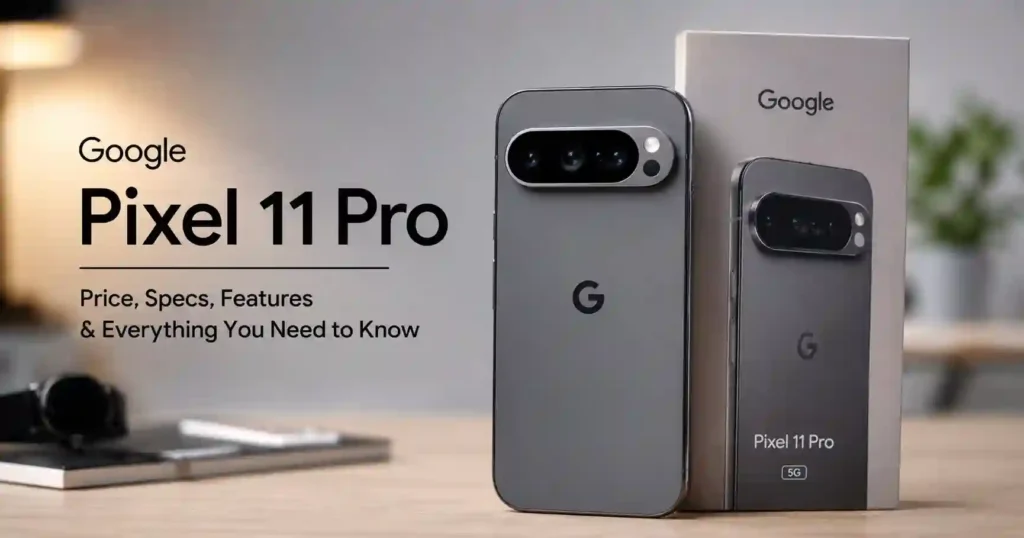 Which Google Pixel 11 Pro Configuration Is Best for Most Buyers?
The 256GB Google Pixel 11 Pro is the best starting configuration for most buyers because it combines the Pro hardware with 12GB of RAM and the lowest listed price.
Google Pixel 11 Pro 256GB / 12GB RAM
BEST OVERALL
Best For: Most buyers who want the Pixel 11 Pro without paying for maximum storage.

Google Pixel 11 Pro - Unlocked Smartphone, Gemini - 256 GB - Olive
The 256GB Google Pixel 11 Pro is positioned as the best overall configuration for most buyers because it combines the flagship Pixel 11 Pro hardware with 12GB of RAM at the lowest listed configuration price. It offers Tensor G6, a 6.3-inch Super Actua display, a triple-camera system, Pixelsnap wireless charging, and Google's Gemini-powered features.
Who Should Buy It
Best for buyers who want the Pixel 11 Pro without paying for maximum storage. It is also a good fit for users with typical app, photo, video, and document storage needs.
Why We Pick It
It earned the Best Overall position because it provides the most balanced combination of storage, RAM, flagship features, and price among the supplied Pixel 11 Pro configurations. The article identifies 256GB as sufficient for most normal users while reserving 512GB and 1TB for heavier storage needs.
Features & Benefits
| Feature | Benefit |
|---|---|
| 256GB storage | Provides substantial space for apps, photos, videos, documents, and everyday downloads |
| 12GB RAM | Provides the standard memory configuration for the entry Pixel 11 Pro |
| Tensor G6 | Supports the phone's performance and AI-focused features |
| 6.3-inch Super Actua display | Provides a compact flagship screen with 1–120Hz refresh rate and up to 3,600 nits peak brightness |
| Triple rear-camera system | Combines a 50MP main camera, 48MP ultrawide, and 48MP 5x telephoto for versatile photography |
| Pixelsnap Qi2.2 charging | Enables compatible wireless charging at up to 25W |
| IP68 protection | Provides dust and water resistance for added everyday durability |
| Gemini features | Supports Google's AI-focused phone experience |
Pros & Cons
| Pros | Cons |
|---|---|
| ✓ Best balance of price and storage | ✕ 256GB may be limiting for heavy video users |
| ✓ Flagship Tensor G6 and camera system | ✕ Higher-capacity versions offer more storage |
| ✓ Compact 6.3-inch Pro design |
The 256GB configuration gives most users enough space for apps, photos, videos, documents, and everyday downloads. It also keeps the entry price lower than the larger storage versions.
The main reason to choose this configuration is simplicity. You get the same core Pixel 11 Pro platform, including Tensor G6, the Pro triple-camera system, the 6.3-inch Super Actua display, and Pixelsnap wireless charging.
Buyers who record large amounts of 4K video or keep years of media locally may prefer 512GB or 1TB. For normal flagship use, however, 256GB is the more balanced choice.
💡 Pro Tip: Choose storage based on how you actually use your phone. Paying for 1TB makes more sense for large local media libraries than for ordinary app and photo use.
What Are the Google Pixel 11 Pro Specifications?
The Google Pixel 11 Pro combines a 6.3-inch LTPO OLED display, Tensor G6, 12GB or 16GB of RAM, up to 1TB storage, a 4,850mAh battery, and a 50MP-plus triple rear-camera system.
| Specification | Google Pixel 11 Pro |
|---|---|
| Display | 6.3-inch Super Actua LTPO OLED |
| Refresh rate | 1–120Hz Smooth Display |
| Resolution | 1280 × 2856 |
| Peak brightness | Up to 3,600 nits |
| Processor | Google Tensor G6 |
| RAM | 12GB or 16GB |
| Storage | 256GB, 512GB, or 1TB |
| Main camera | 50MP wide |
| Ultrawide camera | 48MP with Macro Focus |
| Telephoto camera | 48MP, 5x optical zoom |
| Pro Zoom | Up to 120x |
| Front camera | 42MP autofocus camera |
| Battery | 4,850mAh typical capacity |
| Wired charging | Up to 55% in about 30 minutes with compatible charging equipment |
| Wireless charging | Pixelsnap Qi2.2 up to 25W |
| Operating system | Android 17 |
| Durability | IP68 dust and water resistance |
| Connectivity | 5G, Wi-Fi 7, Bluetooth 6, NFC, UWB |
| Security | Titan M3 security coprocessor |
| Updates | Seven years of OS, security, and Pixel Drop updates |
Google’s official hardware documentation lists the Pixel 11 Pro with a 6.3-inch 1280 × 2856 LTPO OLED display, Tensor G6, 256GB/12GB as the base memory configuration, and 512GB and 1TB options with 16GB RAM. The same documentation lists the 50MP wide, 48MP ultrawide, and 48MP 5x telephoto cameras. View the official Pixel 11 Pro specifications.
When Did the Google Pixel 11 Pro Come Out?
Google announced the Pixel 11 Pro on August 12, 2026, and retail availability began on August 20, 2026.
The Pixel 11 series was announced alongside the Pixel 11 and Pixel 11 Pro XL. Google opened pre-orders on August 12, with the Pro model starting at $1,099.
That release timing changes how buyers should research the phone. The Pixel 11 Pro is now a launched device rather than a future release, so official specifications and current retail availability matter more than early rumors.
Read Google’s official Pixel 11 series announcement.
How Much Does the Google Pixel 11 Pro Cost?
The Google Pixel 11 Pro starts at $1,099 for the 256GB configuration.
The supplied product listings show three Pixel 11 Pro configurations. The 256GB model has 12GB RAM, while the 512GB and 1TB models have 16GB RAM.
| Configuration | RAM | Source Price | Amazon |
|---|---|---|---|
| 256GB | 12GB | $1,099 | Check Price |
| 512GB | 16GB | $1,219 | Check Price |
| 1TB | 16GB | $1,449 | Check Price |
Amazon prices can change, so the figures above should be treated as source-listed prices rather than permanent prices. The supplied GSMArena data lists $1,099, $1,219, and $1,449 for the three configurations.
Which Google Pixel 11 Pro Storage Size Should You Buy?
Choose 256GB for normal use, 512GB for heavy storage needs, and 1TB if maximum local storage is a priority.
The storage decision is more important than the RAM difference for many buyers. All three configurations use the same Pixel 11 Pro platform, but the higher-capacity versions provide more room for large media libraries.
- 256GB: Best balance for most users.
- 512GB: Better for frequent photo and video recording.
- 1TB: Best for users who keep very large files locally.
If cloud storage is already part of your workflow, 256GB may be enough. If the phone will serve as your main camera and video archive, 512GB provides more breathing room.
What Does the Google Pixel 11 Pro Look Like?
The Pixel 11 Pro uses a compact Pro design with a 6.3-inch display, glass construction, an aluminum frame, and Google’s distinctive camera bar.
The phone measures 152.7 × 71.9 × 8.4mm and weighs 204g. The display uses Gorilla Glass Victus 2, while the phone carries an IP68 dust and water-resistance rating.
Google also introduced four Pixel 11 Pro colors: Canyon, Fog, Olive, and all-matte Obsidian.
The design remains recognizably Pixel. However, the new generation focuses more on durability and scratch resistance rather than a complete visual redesign.
How Good Is the Google Pixel 11 Pro Display?
The Pixel 11 Pro has a 6.3-inch LTPO OLED display with a 1–120Hz refresh rate and up to 3,600 nits peak brightness.
The 1280 × 2856 resolution gives the display a sharp 495-pixel-per-inch density. The LTPO panel can vary its refresh rate between 1Hz and 120Hz, which helps balance smooth scrolling with efficiency.
The high peak brightness is especially useful outdoors. However, peak brightness figures are measured under specific conditions, so they should not be treated as a constant screen brightness level.
Gorilla Glass Victus 2 provides the cover glass, while Google also highlights an improved anti-scratch coating compared with the previous Pro generation.
How Good Is the Google Pixel 11 Pro Camera?
The Pixel 11 Pro uses a 50MP main camera, 48MP ultrawide, and 48MP 5x telephoto system with Pro Zoom up to 120x.
The main camera uses a 50MP sensor with optical image stabilization. The 48MP ultrawide camera adds autofocus and Macro Focus, while the 48MP telephoto camera provides 5x optical zoom.
The telephoto upgrade is particularly important for people who photograph distant subjects. Google also enables Portrait Mode at 5x and combines the camera hardware with Tensor G6 processing.
Pro Zoom reaches up to 120x, although maximum digital or computational zoom should not be treated as equivalent to optical zoom. Google also notes that results can vary by camera, app, and shooting mode.
Low-light photography is another major focus. Google says the redesigned system allows Night Sight images to be captured up to 4.5 times faster than before under its stated comparison conditions.
The front camera is a 42MP autofocus camera with a 103-degree field of view. That makes it useful for selfies, group shots, and video calls where a wider framing is helpful.
What Camera Features Does the Google Pixel 11 Pro Have?
The Pixel 11 Pro combines its camera hardware with features such as Magic Capture, Camera Looks, Pro controls, Night Sight, Macro Focus, and Pro Zoom.
Magic Capture is designed to help capture brief moments. Camera Looks focuses on giving users more control over the visual style of their images.
The phone also includes software tools for editing and video creation. These features matter because Pixel photography depends heavily on the interaction between camera hardware, Google’s image processing, and AI.
For buyers, the practical advantage is not simply the megapixel count. The more important question is whether the combination of camera hardware and Google’s computational photography fits the way you shoot.
How Fast Is the Google Pixel 11 Pro With Tensor G6?
The Pixel 11 Pro uses Google’s Tensor G6 processor, which is designed to improve everyday performance and on-device AI processing.
Google says Tensor G6 delivers a 25% improvement in web browsing and 15% faster app launches compared with Tensor G5 at launch, based on Google’s internal data.
Google also says the chip provides 50% more TPU compute and can process on-device AI tasks up to 3.5 times faster while using up to 3.5 times less energy under its stated comparison conditions.
Those figures are manufacturer claims. They should not be presented as independent benchmark results.
For buyers, Tensor G6 matters most because Google is using the processor to power camera processing, Gemini Nano, and other AI experiences. It is therefore better understood as an AI-focused platform rather than simply a benchmark component.
How Long Does the Google Pixel 11 Pro Battery Last?
Google rates the Pixel 11 Pro for more than 30 hours of battery life, with a typical 4,850mAh battery capacity.
Google’s stated battery-life figure is a manufacturer estimate. Actual endurance depends on network conditions, screen brightness, apps, camera use, gaming, and other factors.
The phone supports wired fast charging and Pixelsnap wireless charging. Google specifies up to 25W wireless charging through Qi2.2-certified Pixelsnap charging.
A compatible 30W USB-C PPS charger can charge the phone to about 55% in around 30 minutes under Google’s specified testing conditions. The charger is sold separately.
💡 Pro Tip: Wireless charging speed depends on the charger, power adapter, case compatibility, temperature, and other conditions. A Qi2-compatible case can help avoid charging problems.
Does the Google Pixel 11 Pro Support Qi2.2 Wireless Charging?
Yes, the Pixel 11 Pro supports Qi2.2-certified Pixelsnap wireless charging at up to 25W.
This makes magnetic wireless charging one of the more useful hardware changes for buyers who use stands, charging docks, or other compatible accessories.
Google recommends suitable USB-C power adapters for reaching the highest supported wireless charging rate. A case that does not properly support Qi2 can also interfere with charging performance.
See Google’s Pixelsnap charging guidance.
What AI Features Does the Google Pixel 11 Pro Have?
The Pixel 11 Pro uses Tensor G6 and Gemini-powered features to make AI a central part of the phone experience.
Gemini Nano runs on the device, while Google’s broader Gemini experience provides assistance for supported tasks. The Pixel 11 series also introduces new features such as HiLight, Magic Capture, and Rambler.
HiLight is designed to provide glanceable notifications without requiring users to look directly at the screen. Google says it can use colored lights around the camera flash for certain notifications and Gemini interactions.
Magic Capture focuses on quickly capturing moments. Rambler is designed around voice transcription and natural speech.
Feature availability can vary by country, language, account, and subscription. Therefore, the article should not imply that every Pixel 11 Pro owner receives every AI capability in every market.
How Durable Is the Google Pixel 11 Pro?
The Pixel 11 Pro has Gorilla Glass Victus 2, an aluminum frame, and an IP68 dust and water-resistance rating.
Google describes the Pro models as its most durable Pro phones yet and highlights improved scratch resistance compared with the previous generation.
IP68 does not mean the phone is permanently waterproof. Water resistance can diminish with wear, damage, repairs, or disassembly.
Buyers should therefore treat the rating as protection against specified exposure conditions, not as permission to intentionally submerge the phone.
What Comes in the Google Pixel 11 Pro Box?
The supplied GSMArena hands-on source reports that the Pixel 11 Pro box includes the phone and a USB-C data cable, with the cable limited to USB 2.0 speeds.
Google’s official specifications also list a 1m USB-C to USB-C cable in the box. The power adapter is sold separately.
This matters if you plan to transfer large video files directly between the phone and a computer. A USB 2.0 cable is slower than the USB 3.x standard used by the phone’s port.
Does the Google Pixel 11 Pro Support 5G and eSIM?
Yes, the Pixel 11 Pro supports 5G and eSIM, but exact SIM and network support depends on the market and carrier.
Google lists dual eSIM support for the U.S. model and a Nano SIM plus eSIM configuration for the rest-of-world model.
5G support also varies by model, carrier, country, and network bands. Buyers should verify the exact regional model before importing a Pixel 11 Pro.
Google Pixel 11 Pro vs Pixel 10 Pro: What Changed?
The Pixel 11 Pro adds Tensor G6, newer camera hardware, a brighter display, faster wireless charging, and additional AI features compared with the previous Pro generation.
| Area | Pixel 11 Pro | Why It Matters |
|---|---|---|
| Processor | Tensor G6 | Newer platform for performance and AI |
| Display | Up to 3,600 nits peak | Better visibility under bright conditions |
| Telephoto | 48MP, 5x optical | Higher-resolution long-range camera hardware |
| Pro Zoom | Up to 120x | Greater computational zoom range |
| Wireless charging | Qi2.2 up to 25W | Faster compatible magnetic charging |
| AI | Tensor G6 and newer Gemini features | More emphasis on on-device AI |
| Updates | Seven years | Long-term software support |
Upgrading makes the most sense for owners who value the newer camera system, Tensor G6, brighter display, charging changes, and new AI features.
Pixel 10 Pro owners who are satisfied with their current camera, display, and performance may not need to upgrade immediately. The value depends on which new features matter to the individual buyer.
For another perspective on flagship Android alternatives, see the Galaxy S26 review.
Pixel 11 Pro vs Pixel 11 Pro XL: Which Should You Buy?
Choose the Pixel 11 Pro for a more compact flagship experience, and choose the Pro XL if you want the larger screen and battery.
| Feature | Pixel 11 Pro | Pixel 11 Pro XL |
|---|---|---|
| Display | 6.3 inches | 6.8 inches |
| Typical battery | 4,850mAh | 5,115mAh |
| Starting price | $1,099 | $1,299 |
| Wireless charging | Up to 25W Qi2.2 | Up to 25W Qi2.2 |
| Best for | Compact Pro buyers | Large-screen and battery-focused buyers |
The Pro XL costs more and is physically larger. In return, it provides a 6.8-inch display and a larger typical battery.
The standard Pro is the better choice if one-handed handling and a smaller footprint matter. The XL is more attractive for people who watch video, read extensively, or simply prefer a large display.
Which Google Pixel 11 Pro Configuration Offers the Best Value?
The 256GB configuration offers the clearest value for most buyers, while 512GB is the better middle ground for heavy users.
The 1TB model is difficult to justify unless large local storage is genuinely important. Storage-heavy users can benefit from it, but most buyers will not need that much capacity.
The 512GB version sits between the two. It adds substantial storage without reaching the 1TB model’s price.
Which Google Pixel 11 Pro Storage Option Is Best for Photography?
The 512GB configuration is the most practical choice for users who take many photos and videos.
Photography itself does not require the 16GB RAM configuration. The main benefit of moving from 256GB to 512GB is storage capacity.
Video files can consume storage quickly, especially when recording high-resolution footage. Buyers who regularly transfer footage from the phone may prefer 512GB or 1TB.
How Should You Choose the Right Google Pixel 11 Pro?
Choose the Pixel 11 Pro configuration according to storage needs, camera use, budget, and how long you plan to keep the phone.
How Much Storage Do You Need?
256GB is enough for many users, while 512GB or 1TB makes more sense for large local media collections.
Check your current phone’s storage usage before buying. If you regularly approach your storage limit, buying the larger capacity can prevent future management problems.
Should You Choose 12GB or 16GB RAM?
12GB RAM is sufficient for most everyday users, while 16GB provides more headroom in the higher-storage configurations.
Do not choose the 512GB or 1TB model solely because of the RAM increase. Storage needs should be the main reason to spend more.
Is the Pixel 11 Pro Good for Camera Users?
Yes, the Pixel 11 Pro is particularly well suited to buyers who prioritize Google’s computational photography and long-range camera features.
The combination of a 50MP main camera, 48MP ultrawide, 48MP 5x telephoto, Pro Zoom, and Google’s image-processing features gives photography a central role in the device.
Is the Pixel 11 Pro Good for Long-Term Use?
Yes, the seven-year OS, security, and Pixel Drop update commitment makes the Pixel 11 Pro suitable for long-term ownership.
Long-term buyers should still consider battery aging, storage requirements, repair costs, and regional support before keeping the phone for many years.
How Can You Avoid Common Pixel 11 Pro Charging Problems?
Use a compatible power adapter, a suitable USB-C cable, and a Qi2-compatible case when using wireless charging.
Google notes that charging performance can vary with the power adapter, temperature, and charging conditions. A phone may also slow or pause charging when it becomes too warm.
If wireless charging is unreliable, remove an incompatible case and confirm that the charger supports the required Qi2 standard. Also make sure the power adapter provides sufficient output.
See Google’s Pixel charging troubleshooting guidance.
What Should You Know Before Buying a Google Pixel 11 Pro?
The biggest buying considerations are price, storage, camera needs, battery expectations, charging, regional network compatibility, and the value of the new AI features.
- Choose 256GB if you want the lowest entry price.
- Choose 512GB if you frequently store photos and videos.
- Choose 1TB if maximum local storage matters more than price.
- Choose Pixel 11 Pro if you want a compact Pro phone.
- Choose Pixel 11 Pro XL if a large display and larger battery matter more.
- Consider Pixel 10 Pro if the current-generation upgrades do not justify the extra cost for you.
For readers considering a less expensive Pixel, the Google Pixel 9a review provides another point of comparison.
Frequently Asked Questions About Google Pixel 11 Pro
What is new with Google Pixel 11 Pro?
The Pixel 11 Pro adds Tensor G6, upgraded cameras, a brighter display, faster Qi2.2 wireless charging, and new AI features.
How much does Google Pixel 11 Pro cost?
The Google Pixel 11 Pro starts at $1,099 for the 256GB configuration.
When did Google Pixel 11 Pro come out?
Google announced the Pixel 11 Pro on August 12, 2026, and retail availability began August 20, 2026.
What are the Google Pixel 11 Pro specifications?
The Pixel 11 Pro has a 6.3-inch LTPO OLED display, Tensor G6, up to 1TB storage, up to 16GB RAM, a 4,850mAh battery, and a triple rear-camera system.
How good is the Google Pixel 11 Pro camera?
The Pixel 11 Pro has a 50MP main camera, 48MP ultrawide, 48MP 5x telephoto, and Pro Zoom up to 120x.
How long does the Google Pixel 11 Pro battery last?
Google rates the Pixel 11 Pro for more than 30 hours of battery life, although actual endurance varies with usage and conditions.
Does Google Pixel 11 Pro support 5G?
Yes, the Pixel 11 Pro supports 5G, but carrier and regional compatibility varies.
Does Google Pixel 11 Pro have eSIM?
Yes, the Pixel 11 Pro supports eSIM, with the exact SIM configuration depending on the regional model.
What colors does Google Pixel 11 Pro come in?
The Pixel 11 Pro comes in Canyon, Fog, Olive, and all-matte Obsidian.
Is Google Pixel 11 Pro unlocked?
Unlocked availability depends on the retailer and market, so buyers should verify the specific listing before purchasing.
What comes in the Google Pixel 11 Pro box?
The phone comes with a USB-C to USB-C cable, while the power adapter is sold separately.
What is the difference between Pixel 11 Pro and Pixel 11 Pro XL?
The Pixel 11 Pro has a 6.3-inch display and 4,850mAh typical battery, while the Pro XL has a 6.8-inch display and 5,115mAh battery.
Is Google Pixel 11 Pro worth buying?
The Pixel 11 Pro is worth considering if you value Google’s cameras, AI features, compact Pro design, and long-term software support.
Which Google Pixel 11 Pro Should You Buy?
The 256GB Pixel 11 Pro is the best choice for most buyers, while 512GB is the stronger option for heavy media users and 1TB is reserved for maximum-storage needs.
The core phone experience remains the same across these configurations. The decision is mainly about how much storage you need and how much you are willing to spend.
If you want a larger screen and battery, the Pixel 11 Pro XL deserves consideration. If you already own a Pixel 10 Pro, the upgrade is most compelling when Tensor G6, the camera improvements, brighter display, charging changes, or new AI features address a real need.
Final Thought
The Google Pixel 11 Pro is a strong choice for buyers who want Google’s most advanced compact Pro phone, especially for photography, AI features, long-term updates, and a bright 6.3-inch display.
- Best Overall: Google Pixel 11 Pro 256GB / 12GB | View Now at Amazon
- Best for Heavy Storage: Google Pixel 11 Pro 512GB / 16GB | View Now at Amazon
- Best for Maximum Storage: Google Pixel 11 Pro 1TB / 16GB | View Now at Amazon
Choose the configuration that matches your storage needs, budget, and long-term plans.