Views: 0
 Is a 7000mAh Battery Smartphone the New Standard?
 Is a 7000mAh Battery Smartphone the New Standard?
A 7000mAh battery smartphone is a device that can finally outlast your busiest weekend without needing a wall outlet. 2026 has officially become the year we stopped carrying bulky power banks because manufacturers finally solved the energy density puzzle. You can now get multi-day endurance in a slim frame that fits comfortably in your pocket.
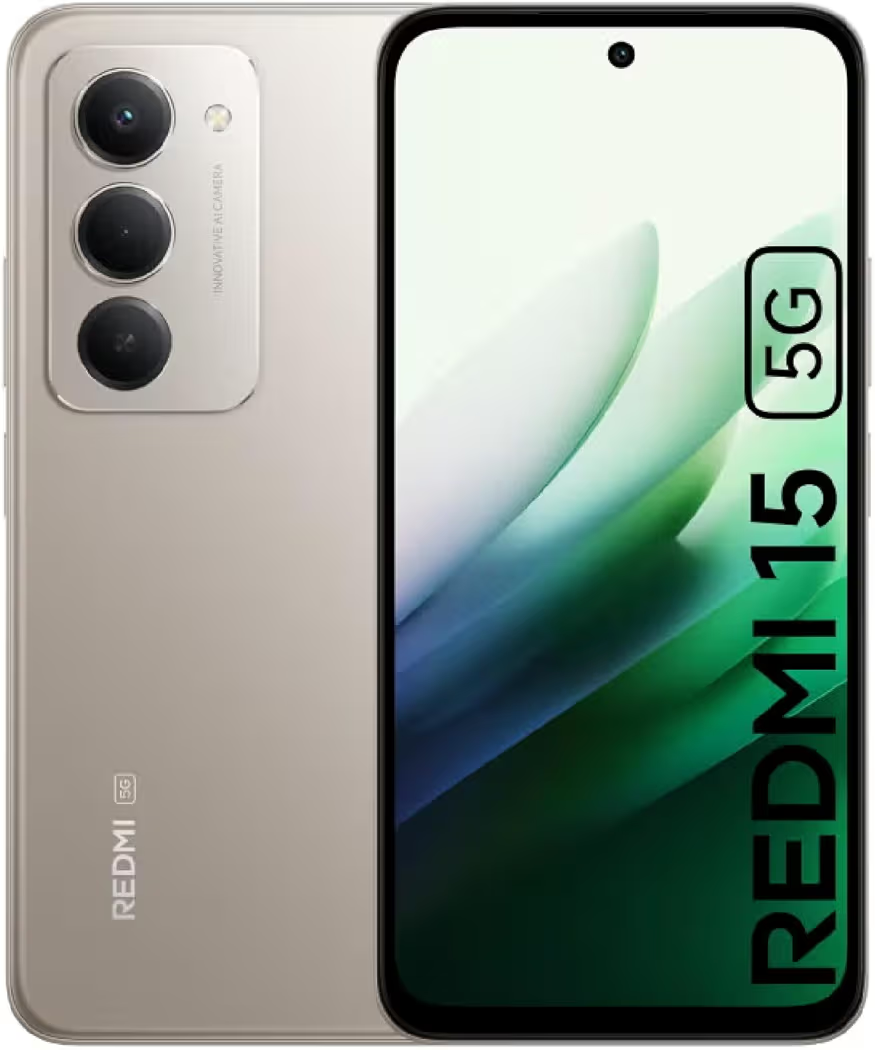
While many users search for the Redmi Note 15 5G expecting a massive cell, it’s actually the Redmi 15 5G that carries the 7,000mAh silicon-carbon monster. The Note version focuses on camera optics, but the standard Redmi 15 is built for pure, unadulterated uptime. If you are tired of your phone dying by 6 PM, this is the shift in mobile technology you have been waiting for.
Note: Silicon-carbon technology allows these batteries to hold more energy without increasing the physical size of the phone.
Also Read Redmi a7 pro review
| Feature | Specifications |
|---|---|
| Battery Capacity | 7,000mAh (Silicon-Carbon) |
| Charging Speed | 33W Turbo + 18W Wired Reverse |
| Real-World Use | Up to 2.3 Days (Light Usage Model) |
| Best For | Travelers, Gamers, Power Users |
Pro Tip: Use the 18W reverse charging feature to power up your wireless earbuds or a friend’s phone using just a USB-C cable.
What is a Smartphone 7000mAh Battery and How Does It Work?
A smartphone 7000mAh battery using silicon-carbon technology works by replacing traditional graphite anodes with a much denser silicon-based composite. This material can store significantly more lithium ions in the same physical space. You get a battery that is 20% more energy-dense, which is why the phone doesn’t feel like a brick.
The Redmi 15 5G stays remarkably slim at just 8.4mm because silicon-carbon anodes don’t require the extra physical volume that old lithium-ion tech demanded. In the past, a 7,000mAh phone would have been over 10mm thick. Today, you get that capacity in a chassis that feels just as thin as a standard flagship.
According to technical data from Xiaomi Global, this 7,000mAh cell maintains 80% health even after 1,600 charge cycles. This works because the carbon in the anode stabilizes the silicon, preventing it from expanding and cracking during fast charging. You’re not just getting a bigger battery; you’re getting a more durable one.
Here’s an example of a quote from industry experts: Silicon carbon anodes can reach an energy density of 600 Wh/kg, compared to just 387 Wh/kg for standard Li-ion. This explains why the Redmi 15 5G can pack nearly 30% more power than the competition without becoming bulkier. Why it works? Better atomic efficiency means more power per gram.
Do you remember when your phone used to get hot just from sitting in your pocket while charging?
How Long Does the Redmi 15 5G Battery Last in Real Life?
The Redmi 15 5G battery lasts approximately 2.3 days under a light daily use model involving web browsing, social media, and occasional calls. In heavy real-world testing, power users can easily push through 18 hours of continuous screen-on time. You won’t find yourself hunting for a charger before you go to bed.
If you are a heavy media consumer, you’ll be happy to know you can get up to 25 hours of continuous YouTube video playback on a single charge. This is a massive jump from the 14 to 16 hours we usually see on standard 5,000mAh devices. It means you could fly from Lagos to New York and still have 40% battery left when you land.
When we compare it to the Samsung Galaxy A36, the difference is clear. While the Samsung offers 29 hours of video playback with its 5,000mAh cell, it achieves this through aggressive software throttling. The Redmi 15 5G relies on raw capacity, giving you more freedom to use high-performance settings like the 144Hz refresh rate without fear.
Note: Lab results show that even at 1% battery, the device can provide up to 59 minutes of emergency calling.
- Music Playback: Up to 108 hours
- Continuous Reading: Up to 30 hours
- Standby Time: Over 15 days in optimized mode
- Cold Weather: Reliable performance even at -20°C
Now I’d like to hear from you: Is battery life the most important feature for you when buying a new smartphone?
Why Choose the Redmi 15 Over the Redmi Note 15 5G?
Choosing the Redmi 15 over the Redmi Note 15 5G is the right move if you prioritize extreme battery life and screen size over high-end camera optics. The Redmi 15 offers a massive 7,000mAh battery that provides roughly 27% more capacity than the 5,520mAh cell found in the Note model. You are essentially trading away a faster 45W charging speed for an extra day of real-world usage.
The trade-offs are clear when you look at the display and camera hardware. While the Redmi 15 uses a massive 6.9-inch IPS LCD with a 144Hz refresh rate, the Note 15 5G features a 6.77-inch AMOLED with much higher peak brightness and better color contrast. Similarly, you get a 50MP main sensor on the standard model versus the 108MP OIS-stabilized camera on the Note, making the Note better for photography enthusiasts.
Under the hood, the Snapdragon 6s Gen 3 manages power efficiently on a 6nm process to ensure that 7,000mAh goes as far as possible. This chipset is tuned for sustained efficiency rather than peak burst performance, which prevents the phone from overheating during long gaming sessions. According to data from Qualcomm, this architecture is specifically designed to balance 5G connectivity with ultra-low power consumption for background tasks.
Note: The Redmi 15 is slightly heavier at 217 grams compared to the Note’s 178 grams due to the physically larger battery cell.
How Fast Does a 7000mAh Battery Charge with 33W?
A 7000mAh battery charges from 0% to 50% in approximately 40 minutes when using the official 33W turbo charging adapter. While 33W might sound slow compared to 100W flagships, it is a intentional choice to preserve the long-term health of the high-density silicon-carbon cell. This speed ensures you can get a full day of power during a quick lunch break.
The internal BatteryExtender chip acts as a smart traffic controller that prevents heat buildup during these 33W cycles. It constantly monitors the temperature and voltage, adjusting the current in real-time to avoid the thermal stress that usually kills large batteries. This works because heat is the primary enemy of battery longevity; by keeping the phone cool, the chip ensures the battery doesn’t degrade prematurely.
You also get 18W wired reverse charging, which effectively turns your phone into a high-speed portable power bank. This feature allows you to charge smaller accessories like the Redmi Buds 6 Pro or even another smartphone using a standard USB-C to USB-C cable. In internal tests, 10 minutes of reverse charging from this device provided over 2 hours of music playback for wireless earbuds.
Pro Tip: To reach the maximum 33W speed, always use the original cable provided in the box, as third-party cables often lack the necessary gauge for high-amperage turbo charging.
How to Maintain a 7000mAh Battery for 4+ Years?
Maintaining a 7000mAh battery for over four years is possible thanks to the 1,600 charge cycle guarantee provided by silicon-carbon technology. This means you can charge your phone from empty to full every single day for nearly five years and still retain 80% of the original capacity. This is a massive improvement over older lithium-ion batteries that often failed after just 500 to 800 cycles.
You should take advantage of the Battery Health 4.0 features found in HyperOS 2.0 to automate this protection. This software includes an adaptive charging mode that learns your sleep patterns; it charges the phone to 80% quickly and then waits until just before you wake up to finish the last 20%. This strategy significantly reduces the time your battery spends under high-voltage stress at 100% charge.
Another technical safeguard is the 3.0V low-voltage shutdown system, which is crucial for reliability in extreme cold. In temperatures as low as -20°C, most phone batteries lose their ability to deliver current and simply shut down. The Redmi 15 5G uses a specialized solid-state electrolyte system that allows it to continue functioning, providing up to 12 hours of video playback even in freezing conditions.
As noted in a technical review by Xiaomi Global, this system ensures the phone remains functional for emergency calls even when the chemical reaction inside the battery slows down due to the cold. Why it works? The lower voltage cutoff allows the device to extract more usable energy that traditional systems would leave untapped.
Have you ever had your phone suddenly die on you while you were outside in the cold?
Where Does the Redmi 15 5G Sit in the 2026 Budget Market?
The Redmi 15 5G sits at the top of the budget endurance category, competing directly with the POCO M7 Plus and the Moto G57 Power. While all three devices offer 7,000mAh capacities, the Redmi 15 5G distinguishes itself with its 144Hz high-refresh-rate display and its slim 8.4mm profile. It offers a more premium in-hand feel compared to the bulkier 8.6mm Moto G57 Power.
The price-to-battery ratio makes this device a value masterclass for users who hate charging their phones. You are getting flagship-level endurance and a modern 5G chipset for a fraction of the cost of a premium device. It is specifically designed for the Nigerian market and other regions where consistent power access can be a challenge and multi-day battery is a necessity rather than a luxury.
| Device | Battery Capacity | Process Node | Display Refresh |
|---|---|---|---|
| Redmi 15 5G | 7,000mAh | 6nm | 144Hz |
| Moto G57 Power | 7,000mAh | 4nm | 120Hz |
| POCO M7 Plus | 7,000mAh | 6nm | 120Hz |
Frequently Asked Questions
Is the Redmi Note 15 5G waterproof or just splash resistant?
The Redmi Note 15 5G features an IP66 rating, which means it is highly resistant to dust and high-pressure water sprays but should not be submerged. It is a step above the IP64 rating of the standard Redmi 15, providing better protection against heavy rain or accidental spills.
Can I use the 7000mAh battery to charge my iPhone?
Yes, you can use the 18W wired reverse charging feature to power an iPhone or any other USB-C compatible device. Simply connect a USB-C to USB-C (or Lightning) cable between the two phones, and the Redmi 15 will automatically act as a power bank.
Why is the Redmi 15 heavier than the Note 15?
The Redmi 15 is heavier because its 7,000mAh battery requires more physical material than the Note 15’s 5,520mAh cell. Even with advanced silicon-carbon technology, a 27% increase in capacity adds roughly 39 grams of weight to the overall device.
Does the 7000mAh battery support wireless charging?
No, the Redmi 15 5G does not support wireless charging to keep the device thin and the price affordable. To charge the massive 7,000mAh cell wirelessly would also generate significant heat, which would counteract the lifespan benefits of the silicon-carbon anode.
How does silicon-carbon technology prevent battery swelling?
Silicon-carbon technology prevents swelling by using a carbon matrix to house the silicon particles, which naturally expand when they absorb lithium ions. This matrix acts like a cage, keeping the physical dimensions of the battery stable even during rapid charge and discharge cycles.
Is the Snapdragon 6s Gen 3 good for high-end gaming?
The Snapdragon 6s Gen 3 is a solid mid-range performer that handles popular games like PUBG or Call of Duty Mobile at medium to high settings. It is built for efficiency rather than flagship gaming performance, so you won’t get the ultra-high frame rates found on more expensive chips.
Where can I buy the global version of the Redmi 15 5G?
The global version of the Redmi 15 5G is available through official Xiaomi retail partners and major online platforms like Amazon and Jumia. Ensure you are buying the 5G model specifically, as some regions may still offer 4G variants with different battery specifications.
Final Thoughts: The End of Battery Anxiety
The 7,000mAh battery in the Redmi 15 5G represents the goldilocks zone for mobile power in 2026. It is large enough to kill battery anxiety for good but advanced enough to stay thin and stylish. If you want a phone that works as hard as you do without needing a midday top-up, this silicon-carbon revolution is the clear winner.
Now I’d like to hear from you: Which feature of the Redmi 15 5G would make your life easier, the 2.3-day battery life or the ability to charge your other devices?

Oluremi Olaoye is a professional driver and technology content contributor based in Ondo, Nigeria. As the founder and primary voice behind Gizmosum, Remi leverages practical, daily experience to help users navigate the complexities of digital banking and consumer electronics. With a specialized focus on mobile hardware and SEO strategy, his work provides reliable guides and technical insights designed to simplify the ever-shifting technological era for a global audience.