
Which TV should you buy when the Hisense U7SG and TCL QM7L cost about the same? The Hisense 65U7SG is the better overall choice for most buyers. It offers stronger reflection handling, better motion, higher refresh rates, and excellent gaming features. The TCL 65QM7L remains a strong alternative if wide color coverage and value matter most.
This comparison focuses on the 65-inch Hisense U7SG and TCL QM7L. Both use Mini-LED backlighting, 4K resolution, quantum-dot color, and Google TV. However, their strengths differ in important ways.
The Hisense U7SG reaches up to 3,000 nits peak brightness and supports a native 165Hz refresh rate. It also has four HDMI 2.1 ports and a glare-reducing screen treatment.
The TCL QM7L also reaches up to 3,000 nits and uses SQD-Mini LED technology. Its 144Hz panel supports VRR and FreeSync Premium Pro, while two HDMI ports support 4K at 144Hz.
U7SG vs TCL QM7L: Which TV Is Better?
The Hisense U7SG is the better overall TV for most buyers because it handles reflections better and offers stronger gaming and motion performance.
The TCL QM7L is still an excellent choice. Its wide color coverage makes it especially appealing for viewers who value vivid, saturated images.
Choose the U7SG if you have a bright room, play games often, or want the most flexible HDMI setup. Choose the QM7L if you find it at a lower price and prefer TCL’s display technology.
Hisense U7SG vs TCL QM7L at a Glance
The two TVs share many premium features, but the U7SG has several important advantages.
- Best overall: Hisense U7SG
- Best for bright rooms: Hisense U7SG
- Best for gaming: Hisense U7SG
- Best color coverage: TCL QM7L
- Best alternative: TCL QM7L
- Smart platform: Google TV on both models
- Display type: Mini-LED with quantum-dot color
Hisense 65U7SG
Best Overall
Best For: Bright rooms, gaming, sports, HDR, and buyers who want a versatile Mini-LED TV.
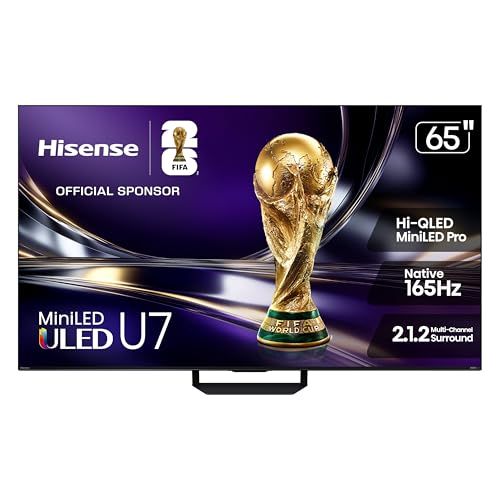
HISENSE
Hisense 65" U7SG Mini-LED 4K Google TV (2026)
The Hisense U7SG wins our head-to-head matchup as the better overall 4K Mini-LED TV. It edges out the TCL QM7L by delivering a superior native 165Hz refresh rate and advanced dual-layer anti-reflection technology that makes it perfect for bright rooms.
Who Should Buy It
Gamers who want a native 165Hz refresh rate and anyone with a bright, sunlit living room who needs advanced glare protection.
Why We Pick It
We chose this model because it offers a more versatile HDMI setup, superior motion handling, and better reflection control than the TCL QM7L at a highly competitive price point.
Features & Benefits
| Feature | Benefit |
|---|---|
| Native 165Hz Refresh Rate | Provides fluid, blur-free motion for fast-paced gaming, sports, and action movies. |
| Dual-Layer Anti-Reflection | Minimizes glare from bright windows and overhead lights so the picture stays clear and crisp. |
| Game Booster 330 | Unlocks ultra-responsive gameplay with VRR support up to 330Hz for a competitive edge. |
| Up to 3,000 Nits Brightness | Creates intense, vivid HDR highlights that stand out even in well-lit rooms. |
Pros & Cons
| Pros | Cons |
|---|---|
| ✓ Native 165Hz panel beats standard 144Hz displays | ✕ May offer more advanced gaming features than casual viewers need |
| ✓ Excellent dual-layer anti-glare screen treatment | |
| ✓ Massive peak brightness up to 3,000 nits |
The Hisense U7SG earns the top position because it combines strong brightness with excellent gaming features.
Hisense rates the U7SG for up to 3,000 nits peak brightness. The 65-inch model also uses 960 local-dimming zones according to Hisense’s published specifications.
The 165Hz native refresh rate gives the U7SG an advantage for fast gaming and sports. VRR operates across a wide range, and AMD FreeSync Premium Pro adds further gaming support.
Another major advantage is the screen treatment. The U7SG uses anti-reflection technology that reduces glare from windows and room lighting. That makes the TV easier to watch during daytime viewing.
Gaming connectivity is also excellent. The 65U7SG has four HDMI 2.1 ports, including an eARC connection.
The built-in audio system is another standout feature. Hisense lists a 50W 2.1.2-channel system with Dolby Atmos support and a built-in subwoofer.
However, the U7SG is not perfect. Independent testing found some weaknesses in black levels and shadow detail. The TV can also show some blooming in difficult scenes.
Buy the U7SG if: you want the strongest overall combination of brightness, gaming, motion, reflection handling, and connectivity.
Skip it if: your main priority is maximum color gamut and the TCL QM7L is substantially cheaper.
See the official Hisense U7SG specifications
TCL 65QM7L
Best Color and Value Alternative
Best For: Movie fans, colorful HDR content, and shoppers looking for a strong Mini-LED value.

TCL
TCL 65-Inch QM7L Series SQD-Mini-LED QLED TV (65QM7L)
The TCL QM7L is a formidable Mini-LED competitor that stands out with its expansive TCL Deep Color System and Ultra Color Filter. It serves as an excellent, high-value alternative to the Hisense U7SG for viewers who prioritize highly saturated, pinpoint-accurate colors and a massive number of dimming zones.
Who Should Buy It
Buyers who want highly vivid, saturated color performance, advanced local dimming, and premium audio integration at a competitive price point.
Why We Pick It
We chose the TCL QM7L for its outstanding SQD-Mini LED backlighting technology, impressive 2,100+ local dimming zones, and specialized 5-nanometer particle Ultra Color Filter that delivers exceptional color precision.
Features & Benefits
| Feature | Benefit |
|---|---|
| SQD-Mini LED & Halo Control | Combines deep colors with precise backlight control to virtually eliminate distracting halo effects around bright objects. |
| TCL Ultra Color Filter | Uses ultra-fine 5nm particles to deliver exceptionally accurate, vibrant, and pure color reproduction across all content. |
| 2,100+ Precise Dimming Zones | Provides incredibly deep, ink-like black levels and localized contrast by dynamically managing thousands of individual LEDs. |
| TCL Game Pack with 288 VRR | Delivers ultra-smooth, low-latency gameplay that pairs perfectly with high-performance consoles and gaming PCs. |
Pros & Cons
| Pros | Cons |
|---|---|
| ✓ Up to 2,100+ precise discrete local dimming zones | ✕ Lower native refresh rate (144Hz) compared to the Hisense U7SG's 165Hz |
| ✓ Highly accurate color reproduction via 5nm Ultra Color Filter | |
| ✓ Premium Bang & Olufsen expandable audio integration | |
| ✓ Excellent gaming suite supporting up to 288Hz VRR |
The TCL QM7L is a strong competitor that gets many important things right.
TCL uses SQD-Mini LED technology in the QM7L. The 65-inch model has up to 2,100+ discrete dimming zones and a claimed peak brightness of up to 3,000 nits.
The 144Hz native refresh rate is fast enough for modern console and PC gaming. VRR and AMD FreeSync Premium Pro are also included.
Color is one of the QM7L’s biggest strengths. Independent testing found excellent Rec. 2020 color coverage, giving the TCL a strong advantage for wide-gamut HDR content.
The QM7L also supports Dolby Vision IQ, HDR10+, HDR10, and HLG. That gives the TV broad HDR format compatibility.
There is one important gaming detail to understand. The TV has four HDMI ports, but only HDMI 1 and HDMI 2 support 4K at 144Hz. HDMI 3 and HDMI 4 operate at 4K 60Hz. 12
That limitation matters if you plan to connect several high-bandwidth gaming devices.
The QM7L also runs Google TV. Therefore, the smart interface remains familiar to users who already use Google’s streaming platform. 13
Buy the QM7L if: you want excellent color coverage, strong HDR performance, and a compelling alternative to the U7SG.
Skip it if: you need four high-bandwidth HDMI connections or frequently watch TV in a room with strong reflections.
See the official TCL QM7L specifications
U7SG vs QM7L: Picture Quality
The U7SG has the better overall picture performance, although the QM7L has an advantage in color gamut.
Both TVs use Mini-LED backlighting and quantum-dot technology. That combination gives both models strong brightness and vibrant colors.
The U7SG has an advantage in out-of-box color accuracy and HDR tone mapping according to independent testing. It also handles low-quality content and motion more effectively.
The QM7L counters with extremely wide color coverage. Independent measurements showed the QM7L covering about 90% of the Rec. 2020 color space in testing. The U7SG measured about 83%.
Therefore, the TCL can produce a wider range of highly saturated colors in compatible content.
For overall consistency, however, the U7SG remains the stronger choice.
U7SG vs QM7L: HDR Brightness
The U7SG has the brighter measured HDR performance in independent testing.
Tom’s Guide measured approximately 2,867 nits for the U7SG using a 10% HDR window. The QM7L measured approximately 2,270 nits in its 75-inch test configuration.
These results do not mean every screen size will perform identically. Panel size, firmware, picture mode, and test method can affect measurements.
Still, the results show that both TVs belong in the high-brightness Mini-LED category.
The U7SG has the edge when HDR highlights need maximum impact.
U7SG vs QM7L: Which Has Better Contrast?
The U7SG has strong contrast, but neither TV matches a high-end OLED in dark-room black levels.
Mini-LED backlighting uses local dimming to control groups of LEDs behind the LCD panel. This improves contrast compared with conventional LED TVs.
However, some blooming can remain around bright objects against dark backgrounds.
The U7SG can also show grayish blacks and weaker shadow detail in some scenes. That weakness is worth considering if you mainly watch movies in a completely dark room.
The QM7L also uses extensive local dimming. Its SQD-Mini LED system helps create strong contrast while maintaining high brightness.
U7SG vs QM7L: Which Is Better for Gaming?
The U7SG is the better gaming TV because it combines a 165Hz refresh rate with four HDMI 2.1 ports.
The U7SG supports native 165Hz gaming, VRR, ALLM, and AMD FreeSync Premium Pro. Hisense also supports Dolby Vision Gaming and HDR10+ Gaming.
The QM7L supports 144Hz gaming, VRR, ALLM, and FreeSync Premium Pro. Its Game Accelerator 288 feature also targets responsive gaming. 17
Both TVs can handle modern consoles well. However, the U7SG provides more flexibility for users with several high-bandwidth sources.
U7SG vs QM7L for PS5
The U7SG is an excellent choice for PS5 owners who want strong HDR and fast gaming performance.
The PS5 does not require 165Hz output, so the U7SG’s maximum refresh advantage does not directly matter to the console.
However, the U7SG’s HDMI 2.1 connectivity and low input lag make it a strong gaming display.
U7SG vs QM7L for PC Gaming
The U7SG has the stronger advantage for PC gaming because its 165Hz panel provides a higher refresh ceiling.
The QM7L remains highly capable at 144Hz. Therefore, the difference matters most to PC gamers with hardware capable of producing very high frame rates.
U7SG vs QM7L for a Bright Room
The U7SG is the better TV for a bright room because its screen treatment reduces distracting reflections.
Hisense specifically markets the U7SG with anti-reflection and glare-reducing technology. 18
That feature matters when windows or lamps sit opposite the television.
The QM7L can still produce high brightness. However, brightness alone does not eliminate reflections from a glossy screen.
For daytime sports, news, and bright living rooms, the U7SG gets the advantage.
U7SG vs QM7L for Movies
The U7SG is the better overall movie TV, but the QM7L remains very competitive.
Both models support Dolby Vision and other major HDR formats. Both also use Mini-LED local dimming for stronger contrast.
The U7SG has stronger HDR brightness and better processing. The QM7L has excellent wide-gamut color performance.
For a bright living room, choose the U7SG. For a controlled room where saturated HDR color matters most, the QM7L deserves serious consideration.
U7SG vs QM7L: Refresh Rate and Motion
The U7SG wins the refresh-rate comparison with its native 165Hz panel.
The QM7L uses a native 144Hz panel. TCL also includes Motion Rate 480 with MEMC processing. 19
Both TVs can display fast sports and games smoothly. However, independent testing found clearer motion on the U7SG.
That makes the Hisense particularly attractive for football, basketball, racing, and other fast-moving content.
U7SG vs QM7L: HDMI and Connectivity
The U7SG offers the more flexible HDMI setup for demanding gaming and home theater systems.
| Feature | Hisense U7SG | TCL QM7L |
|---|---|---|
| HDMI ports | 4 | 4 |
| High-bandwidth HDMI | 4 x HDMI 2.1 | 2 x HDMI supporting 4K/144Hz |
| eARC | Yes | Yes |
| VRR | Yes | Yes |
| ALLM | Yes | Yes |
| USB | 1 x USB 3.0, 1 x USB 2.0 | 1 x USB 3.0, 1 x USB 2.0 |
| Smart platform | Google TV | Google TV |
The key difference is bandwidth. Hisense lists all four HDMI inputs as HDMI 2.1. TCL lists HDMI 1 and HDMI 2 for 4K at 144Hz, while HDMI 3 and HDMI 4 support 4K at 60Hz. 20
U7SG vs QM7L: Smart TV Features
Both TVs use Google TV, so the smart experience is broadly similar.
Google TV provides access to major streaming services and integrates Google Assistant features.
The U7SG also supports Alexa and Apple HomeKit according to Hisense’s specifications. 21
The QM7L includes Google Assistant compatibility and hands-free voice control. 22
Therefore, smart features should not be the deciding factor for most buyers.
U7SG vs QM7L: Sound Quality
The U7SG has the more impressive built-in audio system on paper.
Hisense lists a 50W 2.1.2-channel system with Dolby Atmos and DTS Virtual:X. The system also includes a built-in subwoofer. 23
The stronger built-in audio can make the U7SG more satisfying without a soundbar.
However, a dedicated soundbar will still produce better sound from either TV. This is especially true for larger rooms.
U7SG vs QM7L: Key Differences
The biggest differences become clear when the two TVs are compared feature by feature.
| Category | Hisense U7SG | TCL QM7L |
|---|---|---|
| Overall pick | Hisense 65U7SG | TCL 65QM7L |
| Display | Mini-LED ULED / Hi-QLED | SQD Mini-LED QLED |
| Resolution | 4K UHD | 4K UHD |
| Native refresh rate | 165Hz | 144Hz |
| Peak brightness | Up to 3,000 nits | Up to 3,000 nits |
| Local dimming | 960 zones on 65-inch model | Up to 2,100+ zones |
| HDR | Dolby Vision, HDR10+, HDR10, HLG | Dolby Vision IQ, HDR10+, HDR10, HLG |
| HDMI | 4 x HDMI 2.1 | 4 HDMI, 2 with 4K/144Hz support |
| VRR | Yes | Yes |
| FreeSync | Premium Pro | Premium Pro |
| Smart platform | Google TV | Google TV |
| Screen treatment | Anti-reflection / glare reduction | Standard screen treatment |
| Audio | 50W 2.1.2-channel | Built-in TV speakers |
Specifications can vary by region and screen size. Always check the exact model before ordering.
How to Choose Between the U7SG and QM7L
The best choice depends on how and where you watch TV.
Choose the U7SG for a Bright Room
The U7SG is the better choice for bright rooms because its anti-reflection treatment reduces glare.
Choose the Hisense if windows or lamps create visible reflections on your current TV.
Choose the U7SG for Gaming
The U7SG is the stronger gaming choice because it supports 165Hz and offers four HDMI 2.1 connections.
PC gamers with high frame rates will benefit most from the higher refresh ceiling.
Choose the QM7L for Color Gamut
The QM7L is the better choice if wide color coverage is your priority.
TCL’s SQD technology delivers an exceptionally wide color gamut in independent testing.
Choose the QM7L for Value
The QM7L makes more sense when its street price is meaningfully lower.
Both TVs deliver strong Mini-LED performance. Therefore, a large price difference can change the better value.
Which TV Should You Buy?
The Hisense U7SG is the better overall choice when the two models are similarly priced.
Its 165Hz refresh rate, strong HDR brightness, reflection handling, gaming support, and four HDMI 2.1 ports create a well-rounded package.
The TCL QM7L remains an excellent alternative. Its wide color gamut and strong Mini-LED performance make it a compelling option for movie and HDR enthusiasts.
More importantly, the QM7L becomes easier to recommend when it costs substantially less than the U7SG.
Frequently Asked Questions
Which is better, Hisense U7SG or TCL QM7L?
The Hisense U7SG is better overall based on independent testing and its stronger gaming and reflection-handling features.
The TCL QM7L remains competitive and offers excellent color coverage.
What is the difference between U7SG and QM7L?
The U7SG has a 165Hz refresh rate and stronger reflection handling, while the QM7L uses a 144Hz panel and offers very wide color coverage.
The two TVs also differ in their HDMI bandwidth and processing characteristics.
Which is better for gaming, U7SG or QM7L?
The U7SG is better for gaming because it supports 165Hz and provides four HDMI 2.1 ports.
The QM7L still offers 144Hz, VRR, ALLM, and FreeSync Premium Pro.
Which is better for a bright room, U7SG or QM7L?
The U7SG is better for a bright room because its anti-reflection screen treatment reduces glare.
That advantage matters when windows or lighting face the TV.
Which is brighter, U7SG or QM7L?
The U7SG measured brighter in independent HDR testing.
Both manufacturers advertise peak brightness up to 3,000 nits, but real-world measurements can differ.
Which has better colors, U7SG or QM7L?
The QM7L has the wider measured color gamut, while the U7SG has stronger out-of-box color accuracy in testing.
Therefore, wider color coverage and better accuracy are not exactly the same thing.
Does the U7SG support 165Hz?
Yes, the U7SG has a native 165Hz refresh rate.
Hisense also supports VRR from 48Hz to 165Hz and AMD FreeSync Premium Pro. 24
Does the TCL QM7L support 144Hz?
Yes, the QM7L has a native 144Hz refresh rate.
TCL also includes VRR, ALLM, and FreeSync Premium Pro.
Which TV has more HDMI 2.1 ports?
The Hisense U7SG has the more flexible HDMI 2.1 setup.
Hisense lists four HDMI 2.1 inputs, while TCL lists four HDMI inputs with two supporting 4K at 144Hz and two supporting 4K at 60Hz. 26
Do both TVs support Dolby Vision?
Yes, both TVs support Dolby Vision.
The QM7L supports Dolby Vision IQ, while the U7SG also supports Dolby Vision IQ and Dolby Vision Gaming.
Final Thoughts
The Hisense U7SG wins this comparison overall, especially when gaming, bright-room viewing, and connectivity matter.
The TCL QM7L is still an excellent Mini-LED TV. Its wide color coverage and strong feature set make it a smart alternative when the price is right.
For most buyers, I would choose the U7SG when both TVs cost about the same. If the QM7L is significantly cheaper, however, the TCL can deliver better value.
- Hisense 65U7SG — Best overall for gaming, bright rooms, and versatility.
- TCL 65QM7L — Best alternative for wide color coverage and value.