
Air fryers work by using a heating element and a powerful fan to circulate hot air rapidly around food, creating intense convection that cooks and browns the surface with little or no added oil. The small cooking chamber and perforated basket help move heated air around more of the food, which is why an air fryer can produce a crisp exterior without submerging food in hot oil.
This guide explains how air fryers work, what each major component does, why food becomes crispy, and how air frying compares with a convection oven, conventional oven, deep fryer, and microwave. It also covers practical questions about electricity, foil, parchment paper, liners, baskets, common mistakes, health considerations, and what you can cook in an air fryer.

In simple terms: An air fryer heats air and then moves that hot air rapidly around the food. The heating element supplies the heat, the fan creates airflow, and the basket helps expose more of the food’s surface to the moving air.
Because the process uses circulating hot air instead of a bath of hot oil, an air fryer is better described as a compact, high-intensity convection cooking appliance than a traditional fryer.
What Is an Air Fryer and How Does It Work?
An air fryer is a countertop cooking appliance that uses heated, rapidly circulating air to cook food. Its design combines a heating element, fan, cooking chamber, and basket or tray to create a concentrated convection environment.
The basic process is straightforward:
- The air fryer’s heating element produces heat.
- A fan moves the heated air around the cooking chamber.
- The basket keeps food elevated and exposes more surface area to the airflow.
- Heat transfers from the moving air to the food.
- Moisture leaves the food’s surface as cooking continues.
- Browning reactions help create a darker, crispier exterior.
BBC Science Focus describes an air fryer as a high-intensity convection appliance, while KitchenAid explains that air fryers rapidly circulate hot air around food placed in a perforated basket or tray.
That combination explains why the term “air fryer” can be slightly misleading. The appliance does not fry food by surrounding it with hot oil. Instead, it uses fast-moving heat to create some of the surface characteristics associated with frying.
For readers considering an appliance after learning how the technology works, the next useful step is the best air fryers guide, which focuses on choosing an appliance rather than explaining the cooking principle.
How Do the Main Parts of an Air Fryer Work?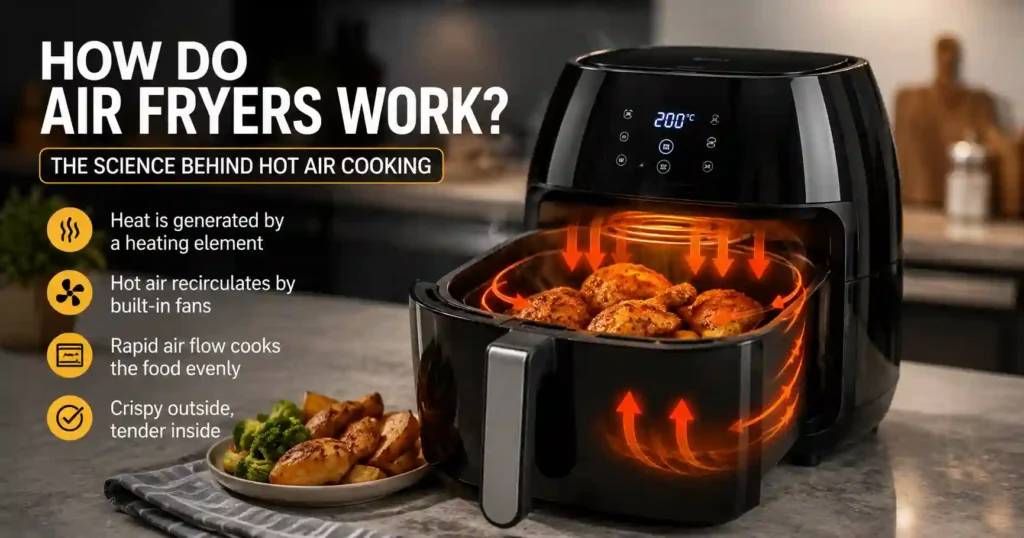
The main air-fryer components work together as one cooking system: the heating element generates heat, the fan moves it, and the basket positions food within the airflow.
How Does the Air Fryer Heating Element Work?
The heating element supplies the heat needed to raise the temperature inside the cooking chamber. In many air fryers, the element sits above the food and works with the fan to distribute heat through the chamber.
The heating element does not cook the food by itself. Instead, it creates the hot environment that the fan then moves around the food.
Some appliances use different heating arrangements or additional heating elements. Therefore, the exact configuration depends on the model and appliance design.
How Does the Air Fryer Fan Work?
The fan circulates heated air rapidly around the food. This forced airflow increases contact between the hot air and the food’s surface.
Air movement matters because stagnant hot air does not provide the same cooking environment as rapidly moving air. The fan helps distribute heat and supports the surface drying and browning that users expect from air frying.
KitchenAid describes air frying as a process that combines heating elements with a fan to circulate hot air around food.
How Does an Air Fryer Basket Work?
An air fryer basket helps food cook by keeping it inside the moving hot-air stream while allowing air to reach more of its surface. Perforations or openings can let heated air move beneath and around the food.
This design is one reason overcrowding can reduce cooking performance. When food is packed too tightly, less hot air can contact individual surfaces.
KitchenAid and Philips both emphasize airflow around food as an important part of air-fryer cooking.
How Does the Cooking Chamber Work?
The cooking chamber creates a relatively small enclosed environment where heat and airflow can work together. Its compact size helps concentrate the cooking energy around the food.
Compared with a large conventional oven, the smaller chamber can require less space to heat. However, exact heating speed and energy use vary between appliances.
How Do the Thermostat and Timer Work?
The temperature control sets the target cooking temperature, while the timer controls how long the cooking cycle runs. Together, they let users control the basic conditions needed for different foods.
The exact controls vary widely. Some models offer only basic temperature and time settings, while others add presets and cooking modes.
Why Does an Air Fryer Make Food Crispy?
An air fryer makes food crispy by combining strong heat transfer with moving air that helps dry the food’s surface and promote browning.
Food usually contains water. During cooking, heat causes moisture near the surface to move away from the food. Once the surface becomes sufficiently dry and hot, browning reactions can contribute to a crisp, browned exterior.
The Maillard reaction is particularly important for the color and flavor associated with many browned foods. BBC Science Focus notes that the intense heat transfer created by rapid airflow can promote browning sooner than in a conventional oven.
Oil can still play a role. A light coating can improve browning and texture for some foods, but air frying does not require the large quantity of oil used for deep frying.
💡 Pro Tip: If food is not crisping properly, check the airflow before simply increasing the cooking temperature. Overcrowding can prevent hot air from reaching enough of the food’s surface.
Does an Air Fryer Work Like a Convection Oven?
Yes, an air fryer works on a convection-style principle because it uses a fan to circulate heated air around food. The main difference is that a typical basket-style air fryer has a smaller cooking chamber and a basket designed specifically to expose food to moving air.
A conventional convection oven also uses a fan and heating system. However, its larger chamber gives the heated air more space to travel.
An air fryer’s smaller cooking area can concentrate heat and airflow around a smaller quantity of food. BBC Science Focus identifies the smaller chamber and ventilated basket as important differences between an air fryer and a typical convection oven.
KitchenAid similarly describes air fryers as using a fan and heating elements to circulate hot air around food in a perforated tray or basket.
So, an air fryer is not a completely different form of cooking from convection. It is better understood as a compact appliance optimized for rapid hot-air cooking.
How Does an Air Fryer Compare With an Oven and Deep Fryer?
An air fryer differs from a conventional oven and deep fryer mainly through the way heat reaches the food and the amount of oil involved.
| Cooking Method | Main Heat Method | Air Movement | Oil Requirement | Typical Result |
|---|---|---|---|---|
| Air fryer | Heating element and hot air | Rapid forced airflow | Little or none for many foods | Crisp, browned exterior |
| Convection oven | Heating element and circulating air | Fan-assisted | Usually none | Even baking and roasting |
| Conventional oven | Heating elements or gas heat | Mostly natural circulation | Usually none | Baking and roasting |
| Deep fryer | Hot oil | Hot oil surrounds food | Large amount | Very crisp fried exterior |
| Microwave | Microwave energy | Not the primary mechanism | No | Fast heating without typical air-fryer crisping |
Does an Air Fryer Work as a Microwave?
No, a standard air fryer does not work as a microwave because the two appliances use different cooking mechanisms.
An air fryer uses a heating element and circulating hot air. A microwave uses electromagnetic energy to heat food.
That difference affects the result. An air fryer is useful when you want browning and crisping, while a microwave is often better suited to rapid reheating.
Some combination appliances include microwave, convection, and air-fry functions in the same machine. In that case, the appliance can use different technologies for different cooking modes.
For example, KitchenAid offers combination microwave appliances with dedicated air-fry modes that use heating elements and fans.
Therefore, an air fryer should not be described as a microwave replacement. A combination appliance is a different case.
Does an Air Fryer Work With Electricity?
Yes, an electric air fryer uses electricity to power its heating system, fan, controls, and other electrical components.
The electricity does not directly “fry” the food. Instead, it powers the components that create the controlled hot-air cooking environment.
Because electrical designs vary, the exact power requirements depend on the specific appliance. Always follow the manufacturer’s electrical requirements and operating instructions.
Does an Air Fryer Work With Foil or Parchment Paper?
Foil and parchment paper can be compatible with some air fryers, but their use depends on the appliance design and manufacturer instructions.
The key issue is airflow. Covering too much of a perforated basket or blocking airflow paths can interfere with the cooking process.
Does an Air Fryer Work With Foil?
Foil may be usable in some air fryers, but it should never be placed in a way that blocks required airflow or creates a hazard near the heating element.
Manufacturer guidance differs between models. Philips, for example, currently warns that covering the basket with foil can reduce airflow and cooking performance on certain Airfryer models. It also warns that loose foil can be drawn toward the heating element. Philips air fryer foil and baking-paper guidance.
For that reason, never assume that foil is universally safe or appropriate for every air fryer. Check the manual for the exact model before using it.
Does an Air Fryer Work With Parchment Paper?
Parchment paper can work in some air fryers when the manufacturer allows it and when the paper does not interfere with airflow.
Loose parchment can move in the strong airflow inside an air fryer. If it reaches a heating element, it can create a safety problem.
Philips documentation specifically warns against using loose baking paper without food holding it down and emphasizes the importance of maintaining airflow. See the manufacturer’s parchment-paper guidance.
The safest general rule is simple: follow the instructions for the exact air fryer rather than assuming that every model handles parchment in the same way.
Do Air Fryer Liners Work?
Air fryer liners work by creating a barrier between food and the cooking surface, but they can also affect airflow if they cover too much of the basket.
A liner should never be treated as a substitute for the basket’s ventilation design. The air fryer still needs enough airflow to cook food effectively.
Some manufacturers provide model-specific accessories and instructions. Therefore, compatibility and placement matter more than the generic label “air fryer liner.”
How Do Air Fryer Baskets and Liners Work?
Air fryer baskets support cooking by holding food in the path of circulating hot air while allowing airflow around and beneath the food.
The basket design can therefore influence cooking performance. A perforated surface gives hot air more opportunities to reach the food.
Food placement matters just as much. If food is stacked too densely, the moving air cannot contact every surface equally.
Philips advises against overcrowding because it can affect air circulation, increase cooking time, and produce less desirable results.
For foods arranged in multiple layers, shaking or turning can also improve exposure to the moving air. Philips specifically recommends shaking certain foods during cooking to promote more even results.
How Do Air Fryer Ovens Work?
Air fryer ovens use the same basic combination of heat and rapid airflow, but they usually provide a larger cooking chamber and a different rack or tray arrangement.
Some countertop ovens include air-fry functions alongside baking, roasting, broiling, or dehydrating. Other appliances build air-fry capability directly into a full-size oven or range.
KitchenAid describes air-fryer ovens as using rapid airflow and intense heat to create a crisp exterior, with fans circulating heated air around food.
The larger format can offer more cooking capacity. However, the larger chamber also changes the cooking environment compared with a compact basket-style air fryer.
For that reason, an air fryer oven and a small basket air fryer should not automatically be expected to produce identical results at the same settings.
How Do You Use an Air Fryer Correctly?
Using an air fryer correctly means preparing the food, maintaining airflow, selecting suitable settings, and checking the food during cooking.
- Set up the appliance: Place it on a stable, level, dry surface with the clearance specified by the manufacturer.
- Prepare the food: Dry appropriate foods, season them, and add oil when the recipe calls for it.
- Load the basket: Avoid unnecessary overcrowding so hot air can reach the food.
- Select the settings: Choose the appropriate cooking temperature and time for the food and appliance.
- Preheat when required: Follow the manufacturer’s instructions because not every model requires the same preheating process.
- Check the food: Shake or turn appropriate foods when the recipe or appliance instructions call for it.
- Confirm doneness: Use appropriate food-safety guidance rather than relying only on appearance.
- Clean the appliance: Allow the appliance to cool and clean the removable components according to the manufacturer’s instructions.
KitchenAid recommends cleaning the appliance before use, placing it on a flat surface, allowing appropriate clearance, distributing food evenly, and following the appliance’s instructions for preheating.
What Are the Most Common Air-Fryer Mistakes?
The most common air-fryer mistakes involve restricting airflow, using unsuitable accessories, or relying too heavily on generic cooking times.
Why Does Overcrowding Affect Air Frying?
Overcrowding reduces the amount of hot air that can reach individual pieces of food.
As a result, some pieces may brown while others remain softer. A single, less crowded layer often gives moving air better access to the food.
Why Is Airflow So Important?
Airflow is important because the air fryer depends on moving heated air to transfer heat around the food.
Blocking the basket, covering ventilation paths, or packing food too tightly can interfere with that process.
Why Is Food Sometimes Not Crispy?
Food may remain soft when the surface contains too much moisture, the basket is overcrowded, or the airflow is restricted.
Food preparation also matters. Drying suitable ingredients before cooking and using an appropriate amount of oil can improve browning and texture.
Why Can Air-Fryer Cooking Times Vary?
Cooking times vary because air fryers differ in design, capacity, airflow, heating systems, and controls.
Food size and starting temperature also affect the result. Therefore, generic cooking charts should be treated as starting points rather than universal guarantees.
Why Should You Follow the Manufacturer’s Manual?
The manufacturer’s manual provides model-specific instructions for temperature, accessories, clearance, cleaning, and materials.
This matters especially when using foil, parchment paper, baking dishes, liners, or racks. Manufacturer instructions take priority over generic internet advice.
Is Air-Frying Healthier Than Deep-Frying?
Air frying can reduce the amount of oil used compared with deep frying, but the healthfulness of the finished meal still depends on the food and recipe.
Deep frying requires food to be surrounded by hot oil. Air frying instead relies mainly on heated air, so many foods can develop a crisp exterior without being submerged in oil.
KitchenAid notes that air frying can use little or no oil for some foods, while BBC Science Focus explains that the cooking method can reduce the amount of oil absorbed compared with deep frying.
However, “air fried” does not automatically mean “healthy.” A highly processed food can still be highly processed when cooked in an air fryer.
For a deeper discussion of the health question, see whether air fryers are bad for you.
What Can You Cook in an Air Fryer?
You can cook many solid foods in an air fryer, including potatoes, chicken, fish, vegetables, tofu, seafood, and various frozen foods.
Foods that benefit from surface browning and crisping are often particularly suitable. Potatoes, chicken wings, breaded foods, and firm vegetables are common examples.
KitchenAid lists foods such as chicken, salmon, shrimp, tofu, steak, zucchini, cauliflower, and sweet potatoes among foods that can work well in an air fryer.
Food preparation still matters. Smaller pieces can expose more surface area to hot air, while a light coating of oil can help some ingredients brown.
What Foods Are Less Suitable for an Air Fryer?
Very wet batters and delicate leafy foods can be difficult to cook effectively in some air fryers.
KitchenAid specifically cautions against wet batters and delicate leafy greens because they can create cooking and handling problems inside the appliance.
The exact limitations depend on the appliance and recipe, so the manufacturer’s guidance should always take priority.
Frequently Asked Questions About How Air Fryers Work
How Does an Air Fryer Work?
An air fryer works by circulating heated air rapidly around food. A heating element produces heat, a fan moves the hot air, and a basket or tray positions the food within that airflow.
What Is an Air Fryer?
An air fryer is a compact cooking appliance that uses heated, rapidly circulating air to cook and brown food. It uses a convection-style process instead of immersing food in hot oil.
Does an Air Fryer Work Like a Convection Oven?
Yes, an air fryer uses convection-style hot-air circulation. Its smaller chamber and basket design are optimized for concentrated airflow around food.
Does an Air Fryer Work as a Microwave?
No, a standard air fryer is not a microwave. An air fryer uses heated air, while a microwave uses electromagnetic energy to heat food.
Does an Air Fryer Work With Electricity?
Yes, electric air fryers use electricity to power their heating element, fan, controls, and other electrical components. The exact electrical requirements depend on the model.
Does an Air Fryer Work With Foil?
Some air fryers allow foil, but the manufacturer’s instructions should determine whether and how it can be used. Foil can interfere with airflow if it covers ventilation areas, and loose foil can create a hazard near a heating element.
Does an Air Fryer Work With Parchment Paper?
Parchment paper can be suitable for some air fryers when used according to the manufacturer’s instructions. It should not be allowed to move freely toward a heating element or block necessary airflow.
How Do Air Fryer Baskets Work?
Air fryer baskets hold food in the hot-air stream while their openings help air circulate around the food. Keeping food from being excessively crowded helps maintain that airflow.
How Do Air Fryer Liners Work?
Air fryer liners create a barrier between food and the cooking surface, but they can affect airflow if they cover too much of the basket. Use only liners that are suitable for the appliance and follow the manufacturer’s instructions.
How Do Air Fryer Ovens Work?
Air fryer ovens use heated air and a fan to circulate heat around food inside a larger oven-style chamber. They can provide more cooking space while using the same basic air-frying principle.
Why Does an Air Fryer Make Food Crispy?
Rapid hot-air circulation helps heat and dry the food’s surface, while browning reactions contribute to a crisp exterior. The exact result depends on the food, airflow, temperature, and cooking time.
Are Air Fryers Healthy?
Air frying can reduce the amount of oil used compared with deep frying, but the overall healthfulness depends on the food being cooked. Air frying changes the cooking method, not the nutritional quality of every ingredient.
What Can You Cook in an Air Fryer?
You can air fry many foods, including potatoes, chicken, fish, vegetables, tofu, seafood, and selected frozen or breaded foods. Foods that benefit from browning and surface crisping are often particularly suitable.
What Should You Remember About How Air Fryers Work?
The simplest way to understand how air fryers work is to remember four parts: heat, airflow, food exposure, and time.
The heating element creates the heat. The fan moves that heat rapidly around the cooking chamber. The basket helps expose the food to the moving air, while temperature and time determine how the cooking process progresses.
That combination makes an air fryer closely related to convection cooking. It also explains why air fryers can produce browned, crisp food without the large quantity of oil required for deep frying.
If you are now deciding whether an air fryer is worth buying, the natural next step is to compare models in the best air fryers guide.
For deeper health information, you can also read our guide to whether air fryers are bad for you.
For additional technical background, see the BBC Science Focus explanation of how air fryers work and KitchenAid’s guide to air fryers and air frying.
Final Thought
Air fryers work by combining a heating element with rapid hot-air circulation around food. The basket and airflow design help expose the food’s surface to that heat, while surface moisture loss and browning create the crisp texture associated with air frying.
The most important distinction is that an air fryer does not work like a deep fryer or microwave. It is a compact convection-style cooking appliance that uses moving hot air rather than a bath of hot oil.
If you understand how heat, airflow, basket design, and food placement interact, it becomes much easier to use an air fryer effectively and choose the right type for your kitchen.
Choose an air fryer based on the cooking capacity, airflow design, controls, cleaning requirements, and features that fit your routine.