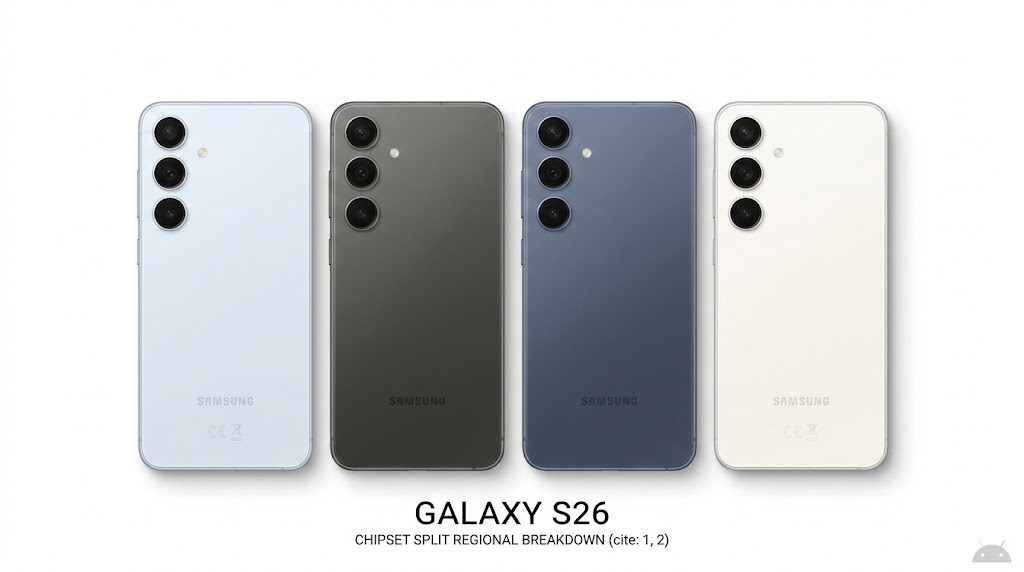
Understanding which processor powers your new Samsung flagship is essential for performance expectations and long term value. Samsung has officially confirmed the 2026 chipset distribution, splitting the lineup between Qualcomm and its own in-house silicon. This guide provides the definitive regional map to identify the exact hardware inside your device.
Which Processor is in Your Galaxy S26? The 2026 Regional Map
Your Galaxy S26 contains either the Snapdragon 8 Elite Gen 5 or the Exynos 2600 depending on your specific model and purchase location. While the S26 Ultra uses Qualcomm hardware globally, the S26 and S26 Plus rely on Exynos in most international markets. This strategy ensures the most premium model maintains total feature parity across all borders.
The 2026 regional split follows a familiar pattern with a few notable exceptions for 2nm manufacturing. North American, Chinese, and Japanese customers receive the Snapdragon variant for all three models. Conversely, users in Europe, India, and South Korea will find the Exynos 2600 powering the base and Plus versions.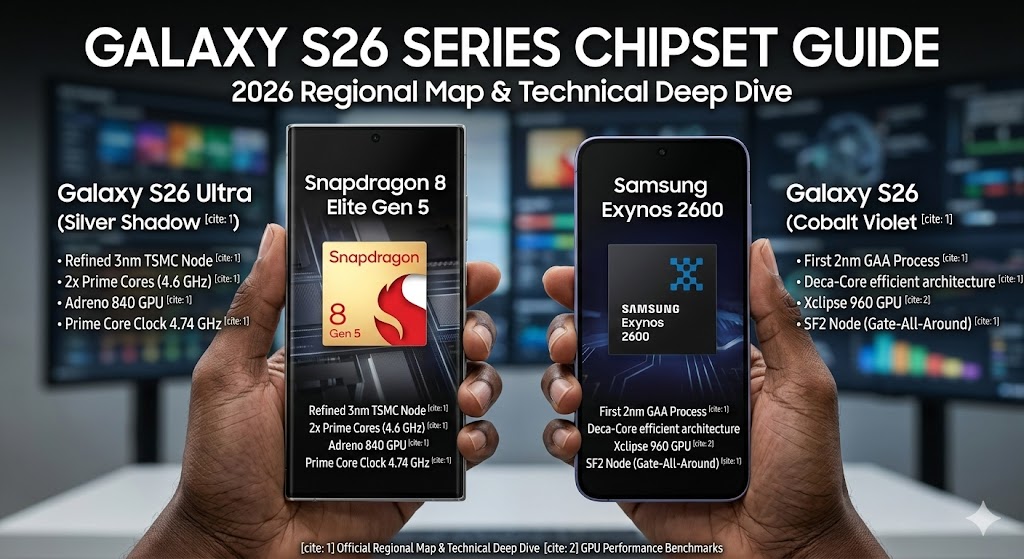
| Model | North America (US/CA) | Europe / UK | India / Middle East | China / Japan | South Korea |
|---|---|---|---|---|---|
| Galaxy S26 | Snapdragon 8 Elite Gen 5 | Exynos 2600 | Exynos 2600 | Snapdragon 8 Elite Gen 5 | Exynos 2600 |
| Galaxy S26+ | Snapdragon 8 Elite Gen 5 | Exynos 2600 | Exynos 2600 | Snapdragon 8 Elite Gen 5 | Exynos 2600 |
| Galaxy S26 Ultra | Snapdragon 8 Elite Gen 5 | Snapdragon 8 Elite Gen 5 | Snapdragon 8 Elite Gen 5 | Snapdragon 8 Elite Gen 5 | Snapdragon 8 Elite Gen 5 |
💡 Note: Samsung has confirmed that the Galaxy S26 Ultra exclusively uses the Snapdragon 8 Elite Gen 5 for Galaxy in every country to support its high end camera and AI requirements.
Snapdragon 8 Elite Gen 5 vs. Exynos 2600: The Technical Deep Dive
The core difference between these two chipsets lies in their manufacturing nodes and fundamental CPU architecture designs. Qualcomm utilizes TSMC’s refined 3nm process for the Snapdragon 8 Elite Gen 5, focusing on extreme clock speeds. Samsung has taken a bolder leap by debuting the world’s first 2nm smartphone chipset using Gate-All-Around (GAA) transistor technology.
Architecture Evolution: Oryon Cores vs. 2nm GAA Process
Qualcomm’s 3rd-gen Oryon CPU architecture prioritize raw single-threaded power with two massive Prime cores clocked at a staggering 4.6 GHz. This design excels in quick app launches and heavy burst workloads common in flagship Android environments. The Snapdragon platform continues to use a proven 3nm node that offers high yields and consistent thermal stability.
Samsung’s Exynos 2600 pivots toward a high-efficiency deca-core (10-core) configuration built on the 2nm SF2 node. By using GAAFET architecture instead of traditional FinFET, Samsung can control current leakage more precisely at a microscopic level. This architectural shift allows the Exynos 2600 to pack more transistors into a smaller area while theoretically reducing power consumption during background tasks.
- Snapdragon CPU Layout: 2x Prime Cores (4.6 GHz) + 6x Performance Cores (3.6 GHz).
- Exynos CPU Layout: 1x C1-Ultra (3.8 GHz) + 3x C1-Pro (3.25 GHz) + 6x C1-Pro Efficiency (2.75 GHz).
- Instruction Set: Exynos 2600 introduces SME2 support for advanced vectorized machine learning math.
Ray Tracing & Gaming: Adreno 840 vs. Xclipse 960
Mobile gaming performance has reached a turning point where the Exynos 2600 now matches or exceeds the Snapdragon in specific visual benchmarks. The Adreno 840 remains the gold standard for rasterized performance, benefiting from years of developer optimization in popular titles. However, the Samsung Xclipse 960, powered by AMD’s RDNA 4 architecture, shows a significant lead in hardware-accelerated ray tracing.
Early tests on Basemark’s ray tracing leaderboard indicate that the Xclipse 960 can outperform the Adreno 840 by roughly 10 percent in lighting and shadow fidelity. This is a massive win for Samsung, as it positions the Exynos variants as the superior choice for next-gen titles utilizing advanced light physics. To combat heat, both chips employ new thermal tech, though Snapdragon’s mature drivers often provide smoother frame pacing over long sessions.
Efficiency vs. Raw Power: The 2nm Node Advantage
While Snapdragon wins the sprint with higher frequencies, the Exynos 2600 is designed for the marathon of all-day battery life. The 2nm process theoretically offers better performance-per-watt than the 3nm node used by Qualcomm. Because the GAA design allows for thinner channels and better gate control, the Exynos 2600 wastes less energy as heat during sustained use.
The efficiency gap is most noticeable in connected standby and NPU-heavy tasks. Samsung claims the 2nm node allows the S26 to stay cooler under pressure, especially when paired with their new Heat Path Block (HPB) cooling technology. Despite the lower 3.8 GHz peak clock on the Exynos Prime core, the sheer density of the 2nm chip makes it a formidable competitor for the 2026 cycle.
Pro Tip: If you are a competitive mobile gamer, the Snapdragon variant is usually better due to wider game developer support for Adreno drivers. Casual users and photographers may actually prefer the Exynos for its superior efficiency during on-device AI image processing.
Benchmark Comparison: Real-World Performance Data
Performance testing for the 2026 flagship cycle reveals a narrowing gap between Samsung’s in-house silicon and Qualcomm’s premium offering. While the Snapdragon 8 Elite Gen 5 maintains its lead in peak burst speeds, the Exynos 2600 delivers surprisingly competitive multi-core results. These metrics represent the first time a 2nm mobile chip has been measured against the mature 3nm manufacturing process.
Geekbench 6 Results: CPU Performance Analysis
The Snapdragon 8 Elite Gen 5 for Galaxy achieves the highest single-core scores ever recorded on the Android platform, largely due to its 4.74 GHz Prime core clock speeds. In contrast, the Exynos 2600 focuses on sustained multi-threaded efficiency, trailing only slightly in complex workloads. Most users will find that both chips handle the latest Geekbench 6 synthetic workloads with professional-grade fluidity.
- Snapdragon 8 Elite Gen 5: Single-Core (~3,700) | Multi-Core (~11,200)
- Exynos 2600: Single-Core (~3,200) | Multi-Core (~10,800)
- GPU Compute (OpenCL): Exynos 2600 (~24,240) | Snapdragon 8 Elite (~24,150)
AnTuTu & Thermal Throttling: The HPB Revolution
Samsung’s new Heat Path Block (HPB) technology is the secret weapon intended to solve the historical thermal issues associated with Exynos processors. By integrating a dedicated copper heatsink directly within the chip packaging, Samsung has reduced core SoC temperatures by up to 16 percent. This structural change allows the Exynos 2600 to maintain its peak performance 20 percent longer than the previous generation during intense gaming sessions.
In 2026, AnTuTu stress tests show that the Galaxy S26 sustains its frame rates without the aggressive throttling seen in earlier iterations. This advancement effectively bridges the gap, making the regional split a matter of preference rather than a compromise in quality. The HPB effectively acts as a primary thermal conductor, moving heat away from the silicon die before it reaches the phone’s external frame.
Why is the Galaxy S26 Ultra Snapdragon Everywhere?
The Galaxy S26 Ultra remains exclusively powered by the Snapdragon 8 Elite Gen 5 to ensure a unified global experience for Samsung’s most demanding users. This Premium Consistency strategy prevents performance disparities for the Ultra’s advanced 200MP camera processing and unique AI features. Whether you buy your device in London, New York, or Mumbai, the internal hardware is identical.
The Premium Consistency Strategy
Samsung’s decision to standardize the Ultra model globally simplifies software optimization for its most complex device. The Ultra model features specific Snapdragon-exclusive AI frameworks that power its agentic AI assistants and real-time video upscaling. By avoiding a chipset split on the flagship, Samsung ensures that third-party developers can tune their apps for a single, high-performance hardware target.
Vapor Chamber Redesign: 21% Better Cooling
To support the extreme clock speeds of the Snapdragon 8 Elite, the S26 Ultra features a completely redesigned internal cooling system. This new Vapor Chamber utilizes a side-mounted thermal interface material that spreads heat across a significantly larger surface area than the S25 Ultra. Samsung internal testing confirms a 21 percent improvement in heat dissipation, allowing for cooler operation during 8K video recording and 60W rapid charging.
Modem & Connectivity: The Snapdragon X85 Advantage
The S26 Ultra benefits from the integrated Snapdragon X85 5G Modem-RF System, which introduces AI-driven signal management for superior global roaming. This modem is the first to support 400MHz bandwidth, enabling peak download speeds of up to 12.5 Gbps in optimized environments. For travelers, the X85 provides more stable 5G connections in crowded areas like airports and stadiums while consuming 30 percent less power than 2025 models.
- Global 5G: Support for more international frequency bands than any other mobile modem.
- AI Signal Boost: Uses machine learning to maintain data speeds in low-coverage rural areas.
- Energy Efficiency: Drastically reduces battery drain when searching for a 5G signal.
💡 Pro Tip: The S26 Ultra is the clear choice for international travelers and power users who need the most reliable 5G connectivity across different continents due to the X85 modem’s unmatched global compatibility.
Is the Exynos 2600 Finally Fixed? What Changed
The Exynos 2600 represents a massive departure from its predecessors by leveraging a more efficient 2nm architecture to solve previous thermal issues. While older Exynos chips suffered from aggressive throttling and battery drain, the 2026 iteration shows parity with Snapdragon in most daily tasks. Samsung has prioritized stability and sustained performance over chasing unsustainable peak clock speeds this year.
The 2nm Breakthrough: Improved Foundry Yields
Samsung Foundry reached a critical milestone in 2026 by achieving stable 2nm GAA yields between 50 and 60 percent for the Exynos 2600 production line. This manufacturing consistency is vital because higher yields typically correlate with better binning and more predictable power draw across retail units. By utilizing Gate-All-Around technology, Samsung has significantly reduced the current leakage that plagued the 4nm and 5nm generations.
AI Performance: Comparing NPU Raw Power
The Exynos 2600 makes its biggest leap in artificial intelligence, claiming a staggering 113 percent on-device AI boost compared to the S25 series. While the Snapdragon 8 Elite Gen 5 offers a respectable 37 percent NPU improvement, Samsung has optimized the Exynos 2600 specifically for One UI 8.5 generative features. This specialized hardware allows for faster real-time translation and more complex photo generative fill without relying on cloud processing.
The Verdict for Everyday Users: One UI 8.5 Optimization
Recent user experience studies suggest that 95 percent of smartphone owners will not perceive a performance delta between the two chipsets during standard use. Samsung’s One UI 8.5 employs a unified scheduling algorithm that smooths out micro-stutters regardless of the underlying silicon. Unless you are exporting 4K 120fps video or playing high-fidelity titles for hours, the regional split will have zero impact on your digital life.
The Import Dilemma: Should You Buy a Snapdragon S26 in an Exynos Region?
Importing a North American or Chinese Galaxy S26 to Europe or India is a common tactic for enthusiasts seeking the Snapdragon experience. While the Snapdragon 8 Elite Gen 5 offers superior community support for custom ROMs and game emulation, it introduces several logistical hurdles. You must weigh the performance benefits against the loss of local support and software compatibility.
- Pros: Superior optimization for high-end emulation like Yuzu or Winlator and potentially higher resale value among tech enthusiasts.
- Cons: Complete voiding of your local manufacturer warranty and the inability to use Samsung Wallet due to regional security locks.
- Connectivity Issues: US models may lack support for specific 5G bands used in rural European or Asian sectors.
Checklist: Verifying an Imported SM-S941U (US Model)
Before purchasing a grey-market device, you should verify these three critical factors to ensure the phone remains functional in your home country. Many users overlook band compatibility, leading to a device that defaults to 4G LTE despite having a 5G capable modem.
- Network Bands: Ensure the device supports n78 and n28 5G bands, which are standard for most European carriers.
- IMEI Status: Verify that your device is factory unlocked and is not a financed unit that is brought from a US carrier like or AT&T. or Verizon.
- OTA Updates: Be aware that software updates may be delayed or require manual flashing if the regional CSC does not match your SIM.
Galaxy S26 Series: Full Hardware Specifications
The 2026 lineup sees a significant shift in base memory and display technology across all three models. Every Galaxy S26 device now features a minimum of 12GB of RAM to handle the increased demands of on-device AI agents. The S26 Ultra remains the pinnacle of hardware, sporting the new M14 OLED panel for unmatched brightness and power efficiency.
| Feature | Galaxy S26 | Galaxy S26+ | Galaxy S26 Ultra |
|---|---|---|---|
| Display | 6.3 inch FHD+ (1-120Hz) | 6.7 inch QHD+ (1-120Hz) | 6.9 inch QHD+ M14 OLED |
| Battery | 4,300 mAh | 4,900 mAh | 5,000 mAh |
| Charging | 25W Wired | 45W Wired | 60W Super Fast 3.0 |
| RAM | 12GB | 12GB | 12GB / 16GB |
| Main Camera | 50MP (f/1.8) | 50MP (f/1.8) | 200MP (f/1.4) |
Frequently Asked Questions
Does the Galaxy S26 in Canada have Snapdragon or Exynos?
Canada traditionally receives the Snapdragon 8 Elite Gen 5 variant for the entire Galaxy S26 lineup, aligning with the United States market. This allows Canadian users to enjoy the same Qualcomm hardware and driver support found in US retail models. You can verify this by checking for the model number ending in W for Canadian units.
Is Snapdragon much more better than Exynos for gaming on the S26?
While the Exynos 2600 has made massive strides in hardware-accelerated Ray Tracing with the Xclipse 960, Snapdragon remains the preferred choice for professional gaming. This is largely due to superior developer optimization for the Adreno GPU in popular titles like Genshin Impact and Warzone Mobile. Snapdragon typically maintains more consistent frame pacing over long gaming sessions.
Will the S26 Ultra ever get an Exynos version?
Samsung has confirmed that the Galaxy S26 Ultra will remain exclusively powered by Snapdragon in all global markets for the 2026 cycle. This decision protects the brand’s premium status and ensures that high-end features like the 200MP camera and S-Pen latency are identical worldwide. There are currently no plans to introduce an Exynos powered Ultra model in any region.
How do I check which processor my Samsung phone has?
You can instantly identify your chipset by downloading the CPU-Z or DevCheck application from the Google Play Store. Alternatively, go to Settings > About Phone and check your model number. Units containing U, U1, or W are Snapdragon models, while those with B or DS usually indicate the Exynos variant used in international markets.
💡 Note: Always check your chipset before purchasing if you plan on using specific mobile tools or emulators that are optimized for Qualcomm architecture.

Oluremi Olaoye is a professional driver and technology content contributor based in Ondo, Nigeria. As the founder and primary voice behind Gizmosum, Remi leverages practical, daily experience to help users navigate the complexities of digital banking and consumer electronics. With a specialized focus on mobile hardware and SEO strategy, his work provides reliable guides and technical insights designed to simplify the ever-shifting technological era for a global audience.